Premium content
Access to this content requires a subscription. You must be a premium user to view this content.

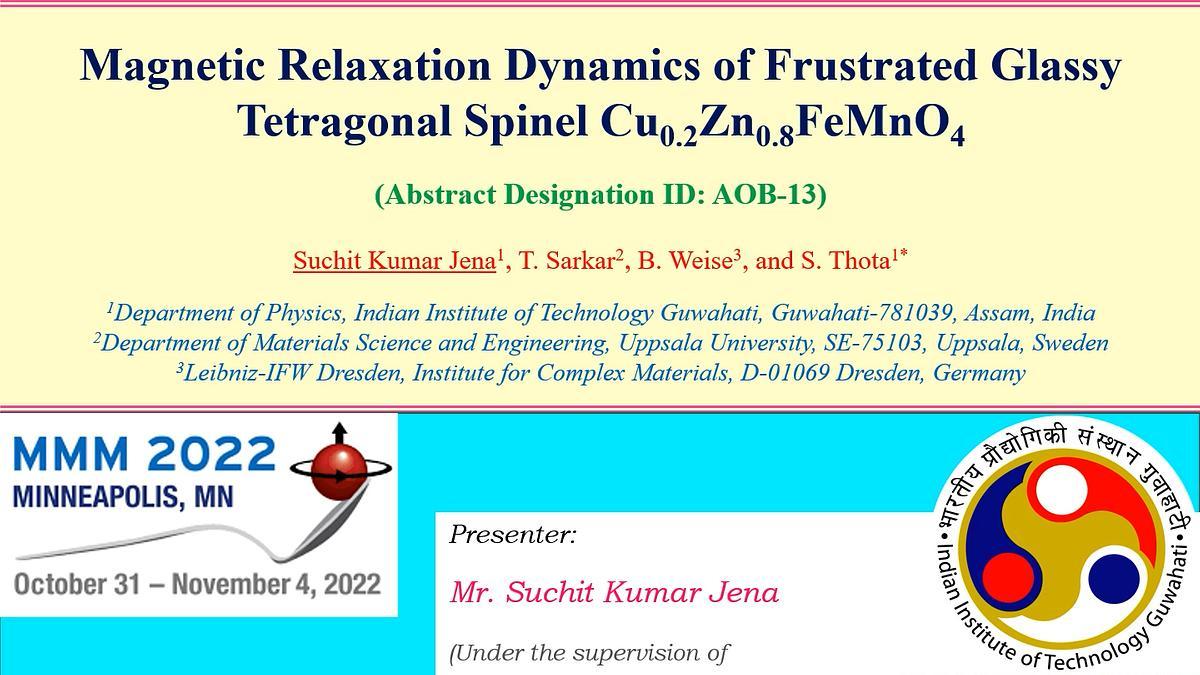
Spinel oxides (AB2O4) are well known materials which possess two important features making them prone to exhibit unusual magnetic properties: (i) competing exchange interactions (JAB, JBB, and JAA) and (ii) the topology of B-sublattice, particularly favorable to the development of geometrical frustration 1,2. Among the various classes of spinels, ZnFe2O4 is a unique system where the B site cations form a network of tetrahedra sharing their corners (similar to Pyrochlore systems), giving rise to high degree of magnetic frustration. These pyrochlore like structures have great applications in magneto-electronic devices 3,4. In the current work we focus on the magnetic relaxation dynamics and heat capacity (CP(T)) studies of polycrystalline bulk Zn(Fe1–xMnx)2O4 where the combined effects from dilute substitution of Jahn-Teller active Cu2+ and Mn3+ ions are expected to alter the exchange coupling significantly by lifting the ground state degeneracy. Our results revealed coexistence of ferrimagnetism (FiM) and spin-glass state in Zn0.8Cu0.2FeMnO4 without signatures of standard long-range ordering, as inferred from the ac-susceptibility (χ′ and χ′′) and CP(T,H) studies. From the χ′′(T) (loss spectrum) shown in fig. 1a, we obtain a main cusp ~ 47.2K along with two more anomalies at 8.9K and 63K. Moreover, the differential analysis (∂(χ′T)/∂T vs. T) yields a local minimum at 79K, referred to as the FiM Néel temperature, TFiM. Frequency dispersion noticed in both χ′(T) and χ′′(T) (fig. 1b) provide the signatures of spin-glass state below TFiM. The empirical-scaling-laws like Vogel-Fulcher law and Power-Law (τ=τ0(T–TSG)/TSG–zυ) are used to determine the spin freezing temperature TSG=41.8K, the critical exponent zυ=8.9 and the relaxation time τ0=1.5×10⁻¹⁰s resulting in the evidence of cluster-spin-glass like state present in Zn0.8Cu0.2FeMnO4. A detailed dc-field dependent static (χDC) and dynamic susceptibility studies further support the glassy characteristics of the system below TFiM.
References
1 S. T. Bramwell, M. J. Harris, B. C. den Hertog, M. J. P. Gingras, J. S. Gardner, D. F. McMorrow, A. R. Wildes, A. L. Cornelius, J. D. M. Champion, R. G. Melko, and T. Fennell, Phys. Rev. Lett. 87, 047205 (2001)
2 G. Srinivasan and M. S. Seehra, Phys. Rev. B 28, 1 (1983)
3 E. Maniv, R. A. Murphy, S. C. Haley, S. Doyle, C. John, A. Maniv, S. K. Ramakrishna, Y. L. Tang, P. Ercius, R. Ramesh, A. P. Reyes, J. R. Long, and J. G. Analytis, Nat. Phys. 17, 525 (2021)
4 W. Schiessl, W. Potzel, H. Karzel, M. Steiner, G. M. Kalvius, A. Martin, M. K. Krause, I. Halevy, J. Gal, W. Schäfer, G. Will, M. Hillberg, and R. Wäppling, Phys. Rev. B 53, 9143 (1996)