Would you like to see your presentation here, made available to a global audience of researchers?
Add your own presentation or have us affordably record your next conference.
Background
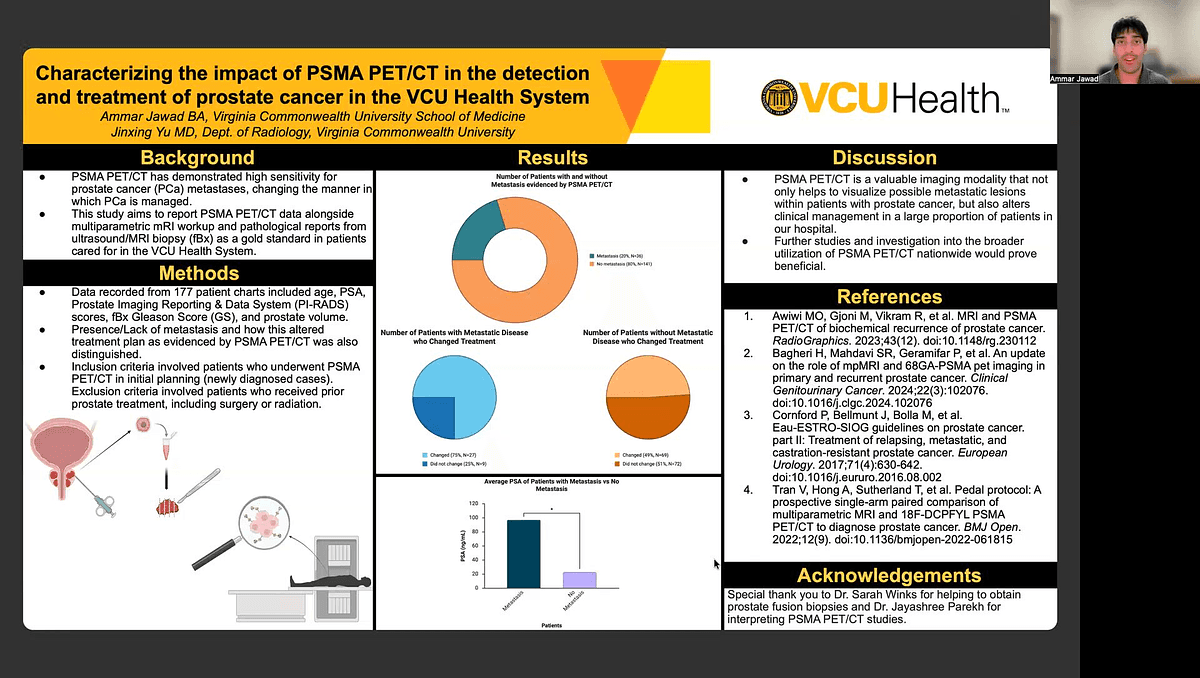
Prostate-specific membrane antigen positron emission tomography/computerized tomography (PSMA PET/CT) has demonstrated high sensitivity for prostate cancer (PCa) metastases, changing the manner in which PCa is managed. This study aims to report PSMA PET/CT data alongside multiparametric mRI workup and pathological reports from ultrasound/MRI biopsy (fBx) as a gold standard in patients cared for in the VCU Health System.
Methods
A retrospective analysis of 765 records of patients who received fBx from January 2022 through December 2024 was conducted. Inclusion criteria involved patients who underwent PSMA PET/CT in initial planning (newly diagnosed cases). Exclusion criteria involved patients who received prior prostate treatment, including surgery or radiation. Data recorded from chart review included age, PSA, Prostate Imaging Reporting & Data System (PI-RADS) scores, fBx Gleason Score (GS), and prostate volume. Additionally, the presence of metastasis and how this altered their treatment plan as evidenced by PSMA PET/CT was also distinguished. There were 177 patients with complete data available for analysis. Statistical analysis was performed with GraphPad.
Results
PSMA PET/CT found 36 patients to be positive for metastatic disease, while 141 were negative. Of those that presented with evidence of metastasis, 27 patients changed their initial treatment plan based on their PSMA PET/CT (75%), compared to 69 patients that presented without metastatic lesions (48.9%). Meanwhile, 9 patients with metastatic involvement as evidenced by PSMA PET/CT did not change their initial treatment regimen (25%), while 72 patients without evidence of metastasis did not (51.1%) The average age of patients included in this study was 68.9 (± 8.61) years. Other descriptive statistics showed an average fBx GS of 7.84 (± 0.97), average PI-RADS of 4.75 (± 0.56), and average prostate volume of 44.65 mL (± 23.49). Lastly, average PSA at time of diagnosis for those with metastasis was 97.13 ng/mL (± 224.53) compared to 23.002 ng/mL (± 52.67) for those without metastasis (p < 0.0406).
Conclusion
PSMA PET/CT is a valuable imaging modality that not only helps to visualize possible metastatic lesions within patients with prostate cancer, but also alters clinical management in a large proportion of patients in our hospital. Further studies and investigation into the broader utilization of PSMA PET/CT nationwide would prove beneficial.