2025 AMA Research Challenge – Member Premier Access

October 22, 2025

Virtual only, United States

Would you like to see your presentation here, made available to a global audience of researchers?
Add your own presentation or have us affordably record your next conference.

Background

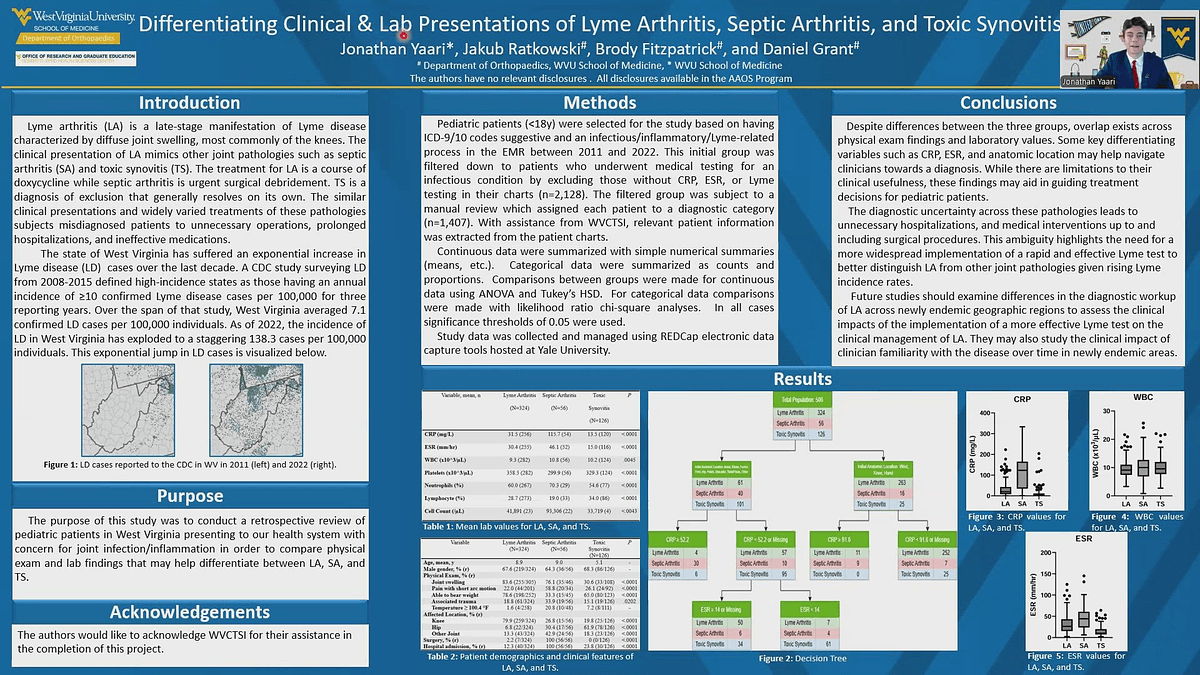
Lyme arthritis (LA) is a late-stage manifestation of Lyme disease characterized by joint swelling and pain. LA’s clinical presentation mimics other pathologies such as septic arthritis (SA) and toxic synovitis (TS). Despite their similar presentations, the necessary treatments vary. LA is treated medically, septic arthritis surgically, and TS resolves with conservative therapy. The similar clinical presentations of these pathologies can lead to misdiagnosis, subjecting patients to unnecessary interventions, and prolonged hospitalizations. The state of West Virginia has suffered an exponential increase in Lyme disease (LD) over the last decade. The CDC defines high-incidence states as those having an annual incidence of ≥10 confirmed LD cases per 100,000 for three reporting years. Over the span of this study, West Virginia averaged 40.3 cases per 100,000. The purpose of this study was to conduct a retrospective review of pediatric patients that presented to our health system with concern for joint infection/inflammation to identify physical examination and laboratory findings that may differentiate between LA, SA, and TS.

Methods

Pediatric patients were selected for the study based on ICD-9/10 codes suggestive of an infectious/inflammatory/Lyme-related process. The initial group was filtered down to patients who had undergone testing for an infectious process. This group was then manually reviewed, and each patient was assigned to a diagnostic category. Relevant patient information was extracted from their charts. Continuous data were summarized with simple numerical summaries and categorical data as counts and proportions.

Results

506 patients were analyzed in this study. Subgroup analysis focused on LA, SA, and TS. Patients with LA had the highest proportion of joint swelling, followed by SA. Pain with short arc motion was most prevalent in the SA group and they were least likely to bear weight. LA favored the knee, TS the hip and SA the knee and hip however other joints were also involved. SA presented with the highest CRP, ESR, WBC, %neutrophils, and cell count values. TS had the lowest elevation in CRP, ESR, %neutrophils, and cell count. TS had the highest %lymphocyte and LA the highest platelet count.

Conclusion

As Lyme disease continues to spread, clinicians will increasingly encounter patients with LA. Clinicians must differentiate between LA and similar pathologies to ensure appropriate treatment and avoid unnecessary interventions. Key differentiating variables, such as anatomic location, CRP, and ESR, can aid in diagnosis, though there are limitations. Clinicians can use this information to guide treatment decisions for these patients.

Downloads

Transcript English (automatic)

Next from 2025 AMA Research Challenge – Member Premier Access

Policy Addendums to Resolve South Korea’s Emergency Room Admission Crisis

Policy Addendums to Resolve South Korea’s Emergency Room Admission Crisis

2025 AMA Research Challenge – Member Premier Access

Destiny Kanning
Destiny Kanning

22 October 2025