Would you like to see your presentation here, made available to a global audience of researchers?
Add your own presentation or have us affordably record your next conference.
Background
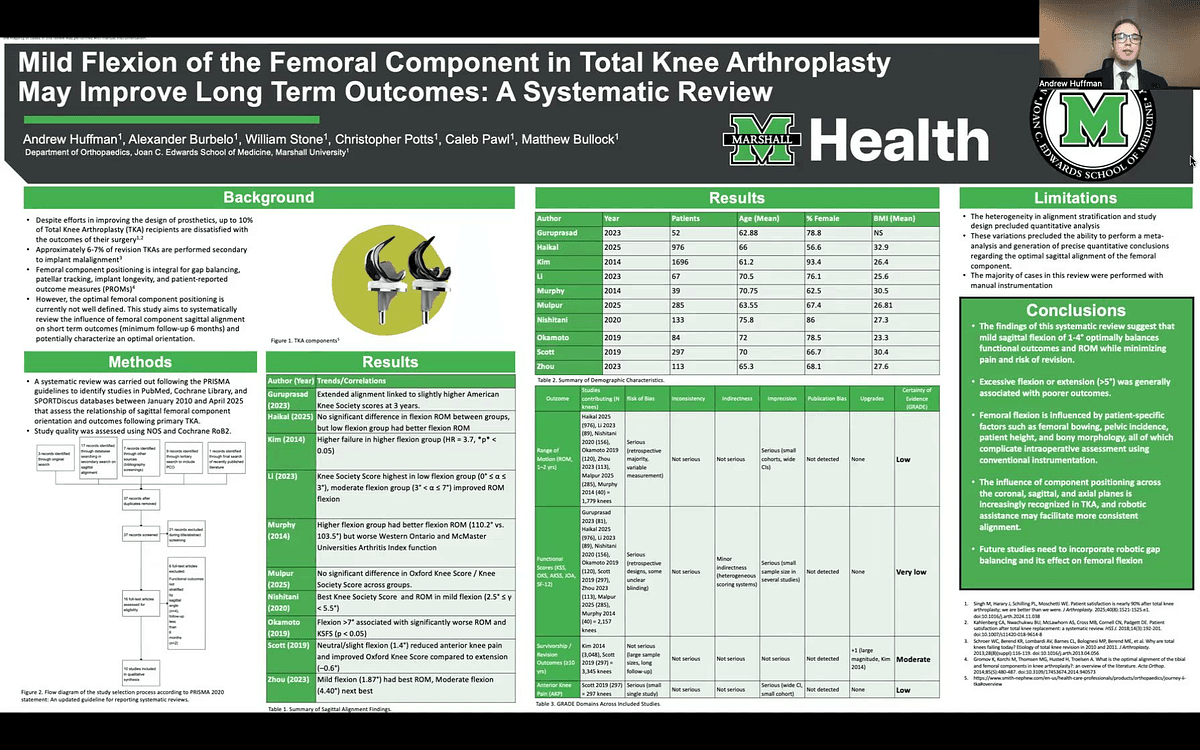
Total Knee Arthroplasty (TKA) is a beneficial procedure in orthopedics, but malpositioning of the femoral TKA component can cause dissatisfaction or failure. Most existing research focuses on coronal and rotational positioning, making positioning in the sagittal plane relatively unexplored. The objective of this systematic review is to determine whether variations in femoral component sagittal alignment (flexion or extension positioning) influence patient-reported outcomes, range of motion, anterior knee pain, component loosening, and prosthesis survival.
Methods
This systematic review was performed according to the guidelines of the Preferred Reporting Items for Systematic Review and Meta-Analyses (PRISMA) protocols (PROSPERO ID number: CRD420251044455). A comprehensive search of PubMed, Cochrane Library databases, and SPORTDiscus was performed between January 2015 and April 2025. Keywords included Total Knee Arthroplasty, Revision Total Knee Arthroplasty, Femoral Component, Sagittal Alignment, Femoral Flexion Angle, Extension Alignment, Posterior Condylar Offset, and Patient-Reported Outcome Measures. After screening 2137 initial results, 10 studies were deemed to meet inclusion and exclusion criteria, with 9 being prospective/retrospective cohort studies and 1 Randomized Control Trial (RCT). Study characteristics and outcomes were extracted, and quality assessment performed for using Cochrane Risk of Bias tool (RCTs) and Newcastle-Ottawa Scale (cohort studies).
Results
A total of 5,205 TKAs were performed among the 10 studies, each with different sagittal alignment grouping thresholds and functional outcome scales. 5/10 studies identified the optimal sagittal alignment to be approximately 1-4° flexion for OKS, WOMAC, KSFS, or KSS functional scores, while 1 study found slightly improved AKSS with 1–5° extension. 2 studies did not identify optimum femoral angles for functional score outcomes. For ROM, 5/10 studies identified the optimum sagittal angle for ROM to be 1-7° flexion. Only 2 studies explored failure rate, with 1 study reporting the best failure rate (0%) in neutral alignment 0-3° and the other stating no cases of loosening at 1 year for any group. Anterior knee pain was only reported by 1 study with best outcomes at 1.4° flexion.
Conclusion
Of the 10 studies, mild sagittal flexion (1-4°) appears to appropriately balance functional outcomes, ROM, survival, and pain. However, the heterogeneity of the included studies in terms of grouping measurement as well as functional outcomes precluded our ability to conduct a meta-analysis and generate exact quantitative outcomes as to the optimal sagittal alignment of the femoral component. More RCTs are needed to explore sagittal component positioning with consistent femoral flexion angle grouping criteria and clinical outcome measurements.