2025 AMA Research Challenge – Member Premier Access

October 22, 2025

Virtual only, United States

Would you like to see your presentation here, made available to a global audience of researchers?
Add your own presentation or have us affordably record your next conference.

Background

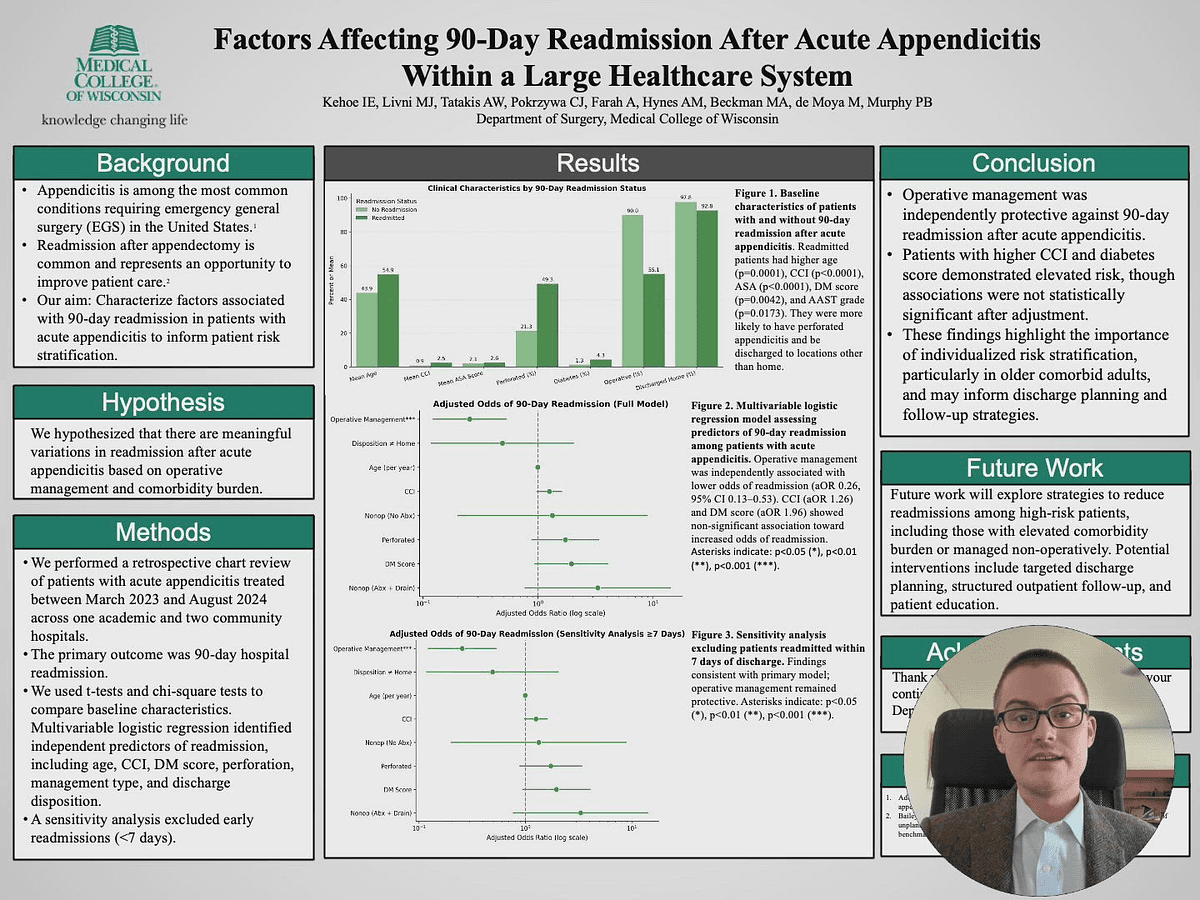
Acute appendicitis is the most common cause of emergency general surgery in the United States and affects 250,000 adults every year. Readmission after appendectomy is common and represents an opportunity to improve care. We aimed to identify factors associated with 90-day readmission in patients with acute appendicitis to inform patient risk stratification.

Methods

We conducted a retrospective chart review of the emergency general surgery registry for patients with acute appendicitis between March 1, 2023, and August 31, 2024, at three hospitals within our healthcare system: one academic (H1) and two community (H2 and H3). Our primary outcome was 90-day hospital readmission. We used descriptive statistics and multivariable logistic regression to assess factors related to readmission, performed a sensitivity analysis excluding early readmissions (<7 days), and stratified models by hospital to evaluate site-level variation.

Results

522 patients with acute appendicitis were included; the overall 90-day readmission rate was 13.0%. Readmitted patients were on average older (56 vs 45 years, p<0.001), had higher Charlson Comorbidity Index scores (CCI) (2.1 vs. 1.2, p<0.001), and more often presented with perforated appendicitis (51% vs. 24%, p<0.001). In multivariable regression, operative management was independently associated with reduced odds of readmission (aOR 0.26, 95% CI 0.12–0.53). CCI (aOR 1.25, 95% CI 0.97–1.59) and diabetes (aOR 1.89, 95% CI 0.91–3.93) increased risk but were not statistically significant. Age, perforation status, and discharge disposition were not significant predictors of 90-day readmission. In sensitivity analysis (n=461), CCI (aOR 1.32, 95% CI 1.01–1.72) and ASA score (aOR 2.23, 95% CI 1.03–4.87) were significant predictors, while operative management remained protective (aOR 0.12, 95% CI 0.06–0.25). Older age was associated reduced readmission (aOR 0.95, 95% CI 0.91–0.99), and diabetes was not significant. Hospital-stratified analysis showed operative management was consistently protective across sites (H1 aOR 0.23, 95% CI 0.09–0.64; H2 aOR 0.04, 95% CI 0.009–0.21; H3 aOR 0.05, 95% CI 0.002–1.21).

Conclusion

Operative management of acute appendicitis was independently protective against 90-day readmission. Higher CCI and ASA scores increased readmission risk, particularly in patients readmitted beyond 7 days post discharge. These findings highlight the importance of individualized risk stratification, particularly in older comorbid adults, and may inform discharge planning and follow-up strategies.

Downloads

Transcript English (automatic)

Next from 2025 AMA Research Challenge – Member Premier Access

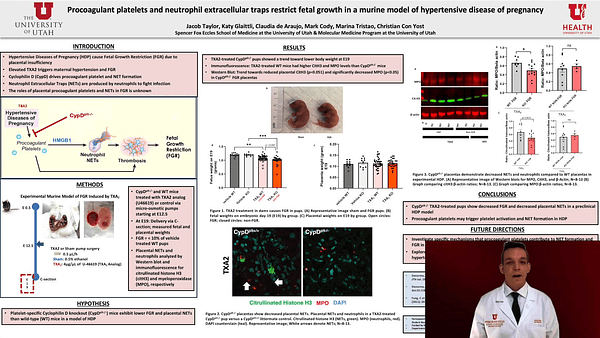
Procoagulant platelets and neutrophil extracellular traps restrict fetal growth in a murine model of hypertensive diseases of pregnancy

Procoagulant platelets and neutrophil extracellular traps restrict fetal growth in a murine model of hypertensive diseases of pregnancy

2025 AMA Research Challenge – Member Premier Access

Jacob Taylor
Jacob Taylor

22 October 2025