2025 AMA Research Challenge – Member Premier Access

October 22, 2025

Virtual only, United States

Would you like to see your presentation here, made available to a global audience of researchers?
Add your own presentation or have us affordably record your next conference.

Background

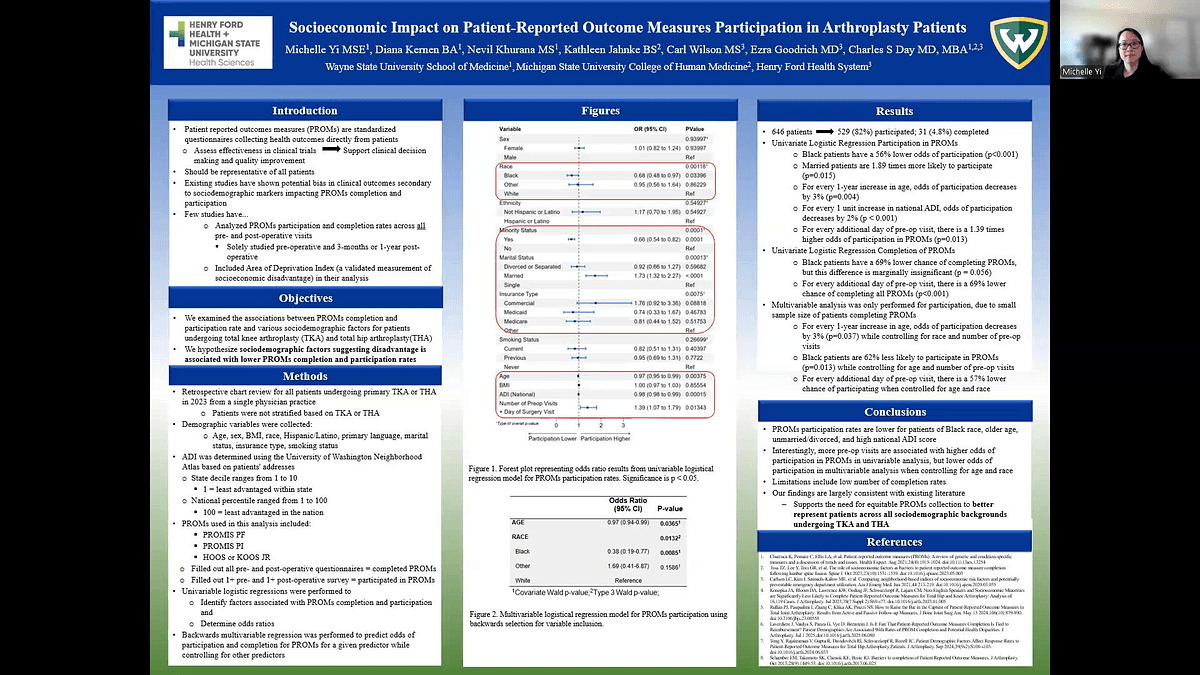
Patient-reported outcomes (PROMs) are standardized questionnaires patients complete to gather information concerning health outcomes, symptoms, and functional status. Prior studies have evaluated completion and/or participation rate across orthopaedic subspecialties. However, few have evaluated both completion and participation outcomes in joint replacement patients specifically. This study aims to determine the association between sociodemographic factors and PROMs completion and participation rates.

Methods

A retrospective chart review was conducted of all patients who underwent primary total knee and total hip replacements by at a Midwestern, tertiary health system in 2023. PROMs used in this analysis included PROMIS PF, PROMIS PI, and either HOOS or KOOS JR. Demographic variables and PROMs completion were recorded, and the Area Deprivation Index (ADI), a measure of socioeconomic disadvantage, was determined using patients’ address. Patients were considered to participate if they filled out at least one questionnaire before and after surgery and were considered to complete PROMs if they filled out all pre- and postoperative questionnaires. Logistical regressions were performed to identify factors associated with PROMs participation and completion.

Results

646 patients were included in our analysis, of which 31 (4.8%) completed all PROMs and 529 (82%) participated in PROMs. In univariate analysis, Black patients had significantly lower odds of PROMs participation (56% lower, p<0.001), as were older patients (OR 0.97; p = 0.004) and patients living in zip codes with high national ADI (OR 0.98; p < 0.001), while married patients were more likely to participate (OR 1.89, p=0.015). In the multivariable model, older age (OR 0.97, p=0.004) and Black race (OR 0.38, p=0.013) were associated with lower participation. Univariate analysis of PROMs completion suggested 69% lower likelihood among Black patients (p=0.056) and with additional preoperative visits (69% lower per day, p<0.001).

Conclusion

Sufficient sociodemographic representation in PROMs is necessary to determine equitable outcomes amongst all members of society. Our data is consistent with established literature with regards to how ADI and age influence PROM completion. Further exploration regarding the factors behind low PROM completion is needed in order to ensure adequate representation in orthopaedic outcomes in clinical and research environments.

Downloads

Transcript English (automatic)

Next from 2025 AMA Research Challenge – Member Premier Access

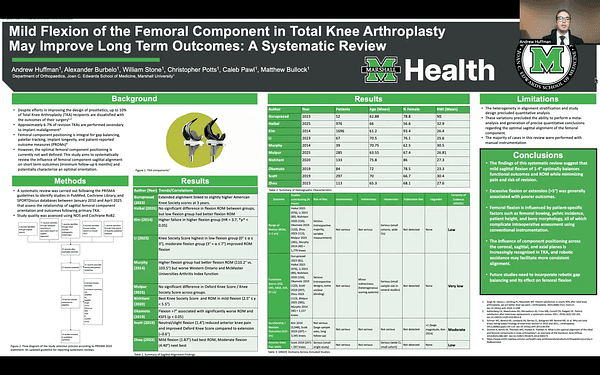
Mild flexion of the femoral component sagittal alignment in TKA may improve long-term clinical outcomes and component survival: A systematic review

Mild flexion of the femoral component sagittal alignment in TKA may improve long-term clinical outcomes and component survival: A systematic review

2025 AMA Research Challenge – Member Premier Access

Andrew Huffman
Andrew Huffman

22 October 2025