2025 AMA Research Challenge – Member Premier Access

October 22, 2025

Virtual only, United States

Would you like to see your presentation here, made available to a global audience of researchers?
Add your own presentation or have us affordably record your next conference.

Background

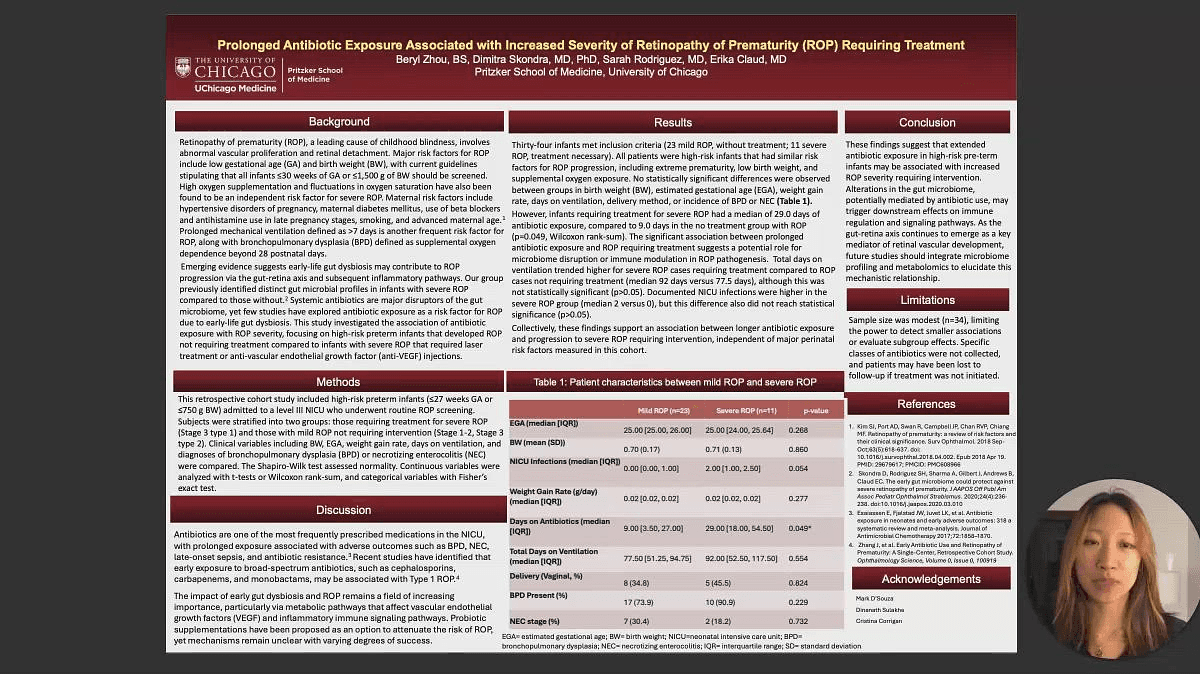
Retinopathy of prematurity (ROP), a leading cause of childhood blindness, involves abnormal vascular proliferation and retinal detachment. Known risk factors include supplemental oxygen exposure, low gestational age (GA), and low birth weights (BW). Emerging evidence suggests early-life gut dysbiosis may contribute to ROP progression via the gut-retina axis and subsequent inflammatory pathways. Our group previously identified distinct gut microbial profiles in infants with severe ROP compared to those without. Systemic antibiotics are major disruptors of the gut microbiome, yet few studies have explored antibiotic exposure as a risk factor for ROP due to early-life gut dysbiosis. This study investigated the association of antibiotic exposure and clinical factors with ROP severity, focusing on high-risk preterm infants that developed ROP not requiring treatment compared to infants with severe ROP that required lasers/injections.

Methods

This retrospective cohort study included high-risk preterm infants (≤27 weeks GA or ≤750 g BW) admitted to a level III NICU who underwent routine ROP screening. Subjects were stratified into two groups: those requiring treatment for severe ROP (Stage 3 type 1) and those with mild ROP not requiring intervention (Stage 1-2, Stage 3 type 2). Clinical variables including BW, EGA, weight gain rate, days on ventilation, and diagnoses of bronchopulmonary dysplasia (BPD) or necrotizing enterocolitis (NEC) were compared. The Shapiro-Wilk test assessed normality. Continuous variables were analyzed with t-tests or Wilcoxon rank-sum, and categorical variables with Fisher’s exact test.

Results

Thirty-four infants met inclusion criteria (23 no treatment, 11 treatment). No statistically significant differences were observed between groups in BW, EGA, weight gain rate, days on ventilation, delivery method, or incidence of BPD or NEC. However, infants requiring treatment for severe ROP had a median of 29 days of antibiotic exposure, compared to 9.0 days in the no treatment group with ROP (p<0.05, Wilcoxon rank-sum). The significant association between prolonged antibiotic exposure and ROP requiring treatment suggests a potential role for microbiome disruption or immune modulation in ROP pathogenesis.

Conclusion

These findings suggest that extended antibiotic exposure in high-risk pre-term infants may be associated with increased ROP severity requiring intervention. Alterations in the gut microbiome, potentially mediated by antibiotic use, may trigger downstream effects on immune regulation and signaling pathways. As the gut-retina axis continues to emerge as a key mediator of retinal vascular development, future studies should integrate microbiome profiling and metabolomics to elucidate this mechanistic relationship.

Downloads

Transcript English (automatic)

Next from 2025 AMA Research Challenge – Member Premier Access

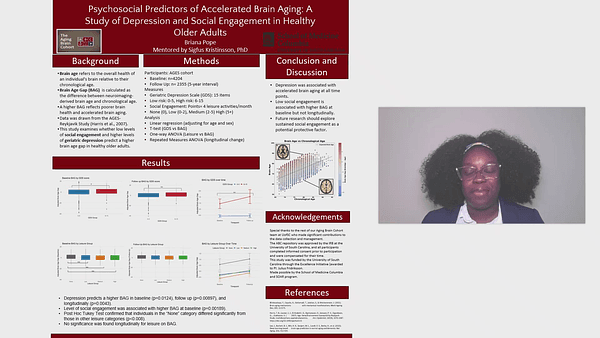
Psychosocial Predictors of Accelerated Brain Aging: A Study of Depression and Social Engagement in Healthy Older Adults

Psychosocial Predictors of Accelerated Brain Aging: A Study of Depression and Social Engagement in Healthy Older Adults

2025 AMA Research Challenge – Member Premier Access

Briana Pope

22 October 2025