Would you like to see your presentation here, made available to a global audience of researchers?
Add your own presentation or have us affordably record your next conference.
Introduction
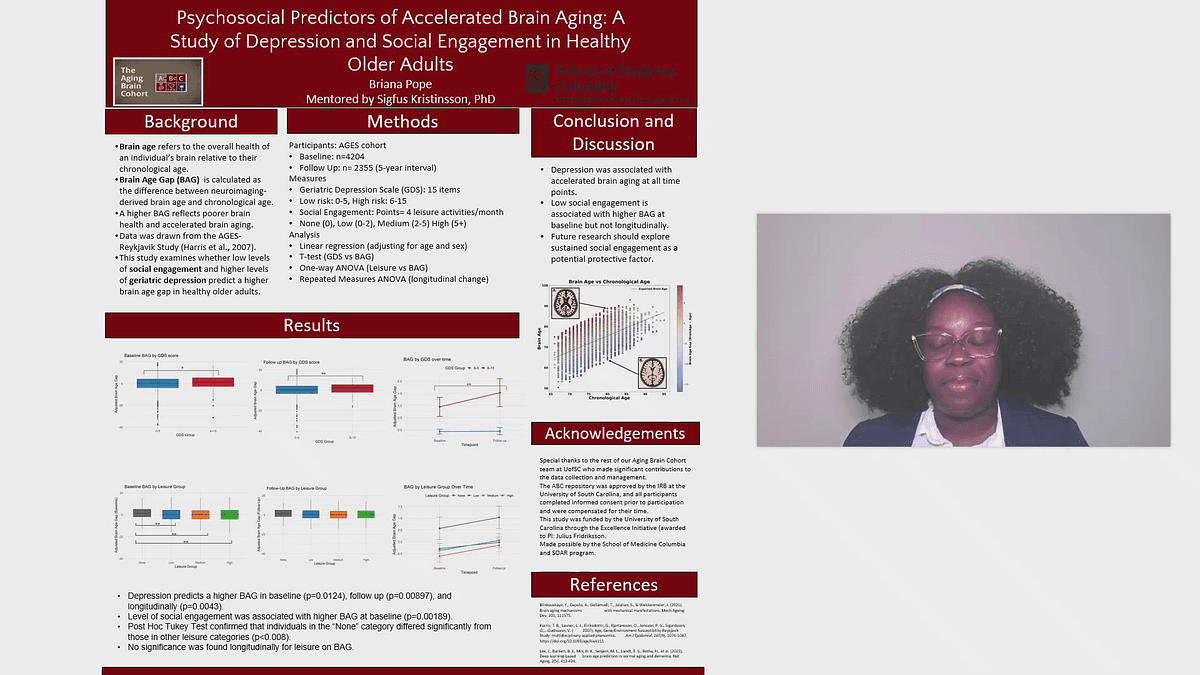
Accelerated brain aging can lead to cognitive decline, as morphological changes occur in the brain. We hypothesize that lower social engagement and higher geriatric depression in older adults pose a greater risk for accelerated brain aging and thus a higher brain age gap (BAG).
Methods
Participants in the AGES study, aged 66 to 96, were surveyed on depression and social engagement at baseline and again after approximately five years. The Geriatric Depression Scale and monthly leisure activity participation were used as measures. Depression scores of 0–5 were categorized as normal/low risk, and scores of 6–15 as moderate/severe risk. For social engagement, each point on the leisure variable corresponded to four leisure activities per month; then categorized into four groups: None (0), Low (0–2), Medium (2–5), and High (5+). Each measure was analyzed using BAG as the dependent variable.
Results
Depression predicted higher BAG at baseline (P< 0.013), follow up (P <0.01) and longitudinally (P< 0.005). Leisure was associated with higher BAG at baseline (P < 0.002), however not at follow-up. A post hoc Tukey test confirmed individuals in the "None" category differed significantly from those in the other leisure groups (P < 0.01). No significance was found longitudinally for leisure on BAG.
Conclusion
Depression has a significant impact on BAG in healthy older adults. Social engagement significantly influences brain aging at baseline, though this effect is not sustained over time; suggesting early intervention may be protective.