2025 AMA Research Challenge – Member Premier Access

October 22, 2025

Virtual only, United States

Would you like to see your presentation here, made available to a global audience of researchers?
Add your own presentation or have us affordably record your next conference.

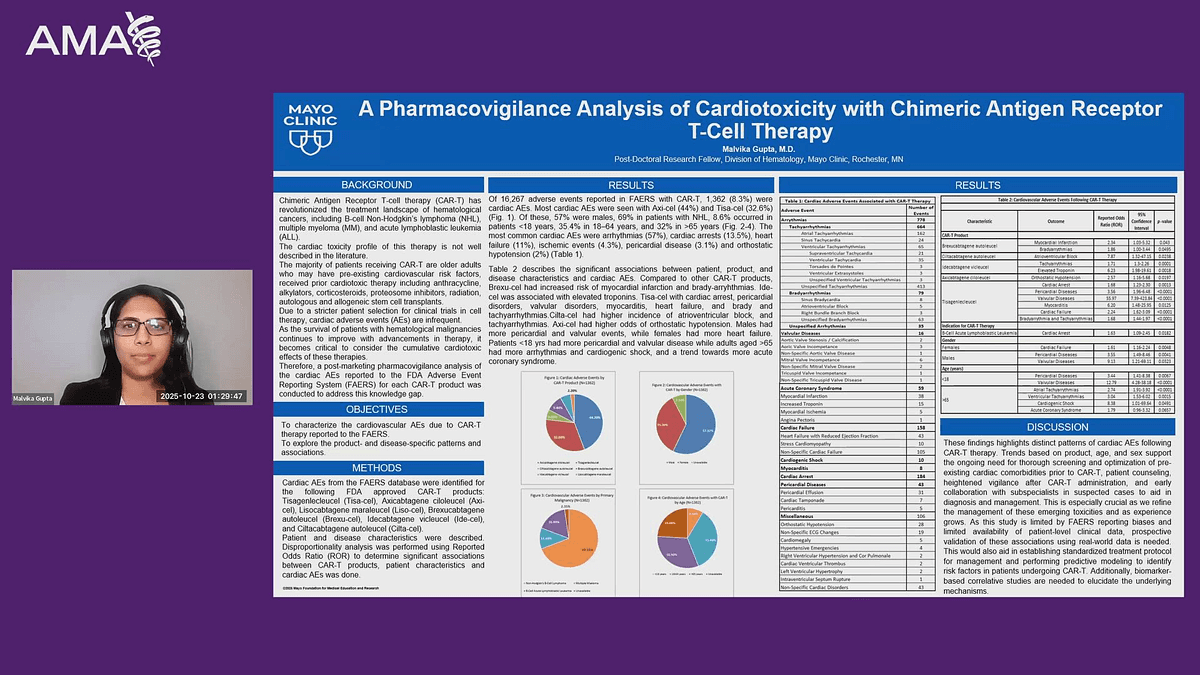
Abstract Title A Pharmacovigilance Analysis of Cardiotoxicity with Chimeric Antigen Receptor T-Cell Therapy

Background Chimeric Antigen Receptor T-cell therapy (CAR-T) has revolutionized the treatment landscape of hematological cancers, including lymphoma, myeloma and leukemia. However, the cardiac toxicity of this therapy is not well described in the literature. This is particularly relevant as the majority of patients receiving CAR-T are older adults with pre-existing cardiovascular risk factors and cumulative burden of organ toxicities from prior therapies. As cancer survival continues to improve with advancements in therapy and CAR-T usage expands, understanding the cardiac toxicity profile is critical to enable safer delivery of care. To address this knowledge gap, a pharmacovigilance analysis of the cardiac adverse events (AEs) reported to the FDA Adverse Event Reporting System (FAERS) for each CAR-T product was conducted.

Methods All individual case safety reports of cardiac AEs listing any of the approved CAR-T therapies Tisagenlecleucel (tisacel), Axicabtagene ciloleucel (axicel), Lisocabtagene maraleucel (lisocel), Brexucabtagene autoleucel (brexucel), Idecabtagene vicleucel (idecel), and Ciltacabtagene autoleucel (Ciltacel) as the suspected drug were identified from the FAERS database. Patient characteristics were described, and disproportionality analysis was performed using Reported Odds Ratio (ROR) to determine significant associations between CAR-T products and cardiac AEs.

Results There were 1362 cardiac AEs with CAR-T reported in the FAERS database. Compared to other products, axicel was associated with higher odds of developing orthostatic hypotension (ROR=2.57, p=0.019), Brexucel with myocardial infarction (MI) (ROR=2.34, p=0.04) and bradyarrythmias (ROR=1.86, p=0.04), Ciltacel with atrioventricular block (ROR=7.87, p=0.02), Idecel with elevated troponin (ROR=6.23, p=0.002) and tachyarrhythmias (ROR=1.71, p=0.0001). Tisacel was associated with cardiac arrest (ROR=1.68, p=0.001), pericardial disorders (effusion/tamponade and pericarditis) (ROR=3.56, p<0.001), valvular disorders (ROR=55.97, p<0.0001), myocarditis (ROR=6.2, p=0.012), arrythmias (ROR=1.68, p<0.001) and heart failure (ROR=2.24, p<0.001). Males were more likely to develop pericardial (ROR=3.55, p=0.004) and valvular disorders (ROR=9.13, p=0.03), while females developed heart failure (ROR=1.61, p=0.005). Patients <18 years developed pericardial (ROR=3.44, p=0.006) and valvular disorders (ROR=12.79, p<0.0001). Older adults (>65) developed acute coronary syndrome (ACS) (ROR=1.79, p=0.06), atrial fibrillation/flutter (ROR=2.74, p<0.0001), ventricular arrythmias (ROR=3.04, p=0.001) and cardiogenic shock (ROR=8.38, p=0.05).

Conclusion This post-marketing pharmacovigilance analysis highlights patterns of cardiac AEs following CAR-T. Distinct AEs, like orthostatic hypotension with Axicel, MI with Brexucel, atrioventricular block with ciltacel, elevated troponin with idecel, cardiac arrest, myocarditis, pericardial and valvular disorders with tisacel, and differences by age and sex were noted, supporting the need for close monitoring strategies. As this study is limited by FAERS reporting bias, prospective studies to validate these associations and elucidate the underlying mechanisms are needed.

Downloads

Transcript English (automatic)

Next from 2025 AMA Research Challenge – Member Premier Access

Reducing Peripheral IV Catheter-Related Thrombophlebitis: Impact of Simple Interventions

Reducing Peripheral IV Catheter-Related Thrombophlebitis: Impact of Simple Interventions

2025 AMA Research Challenge – Member Premier Access

Kumari Priya Yadav
Kumari Priya Yadav

22 October 2025