Would you like to see your presentation here, made available to a global audience of researchers?
Add your own presentation or have us affordably record your next conference.
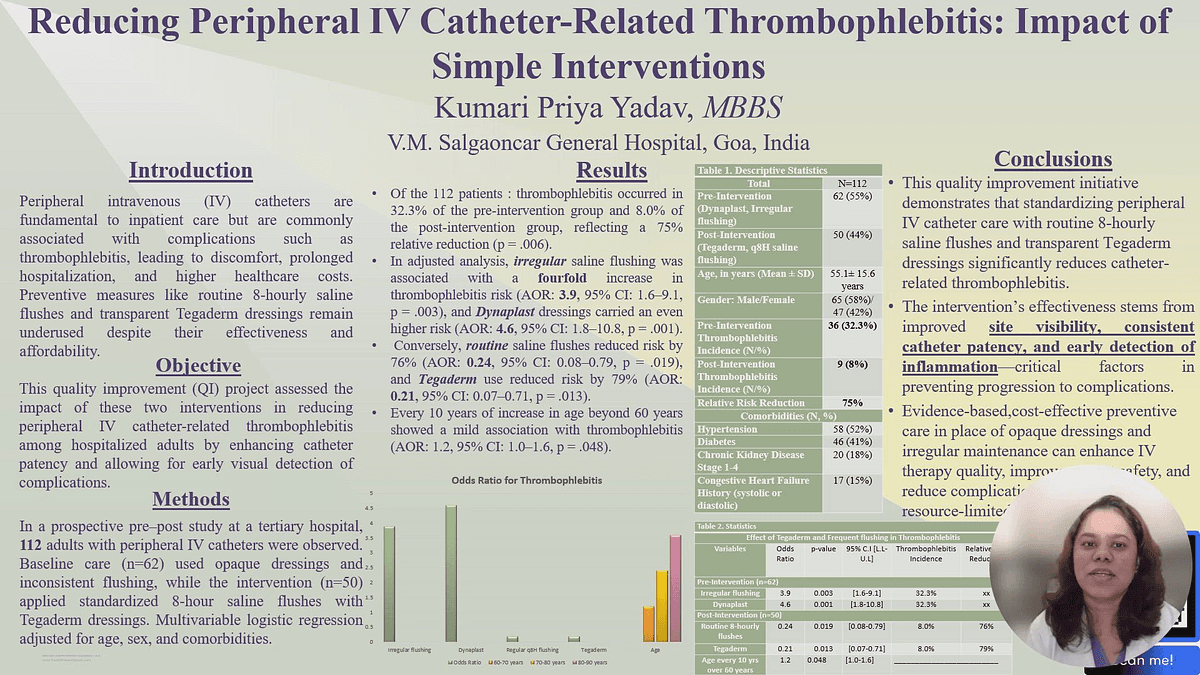
Background Peripheral intravenous (IV) catheters are fundamental to inpatient care but are commonly associated with complications such as thrombophlebitis, leading to discomfort, prolonged hospitalization, and higher healthcare costs. Preventive measures like routine 8-hourly saline flushes and transparent Tegaderm dressings remain underused despite their effectiveness and affordability. This quality improvement (QI) project assessed the impact of these two interventions in reducing peripheral IV catheter-related thrombophlebitis among hospitalized adults by enhancing catheter patency and allowing for early visual detection of complications.
Methods In a prospective pre–post intervention study at a tertiary care hospital, 112 adult inpatients with peripheral IV catheters were observed. During the baseline phase (n=62), usual care included opaque Dynaplast dressings and inconsistent saline flushing. The intervention phase (n=50) implemented standardized 8-hour saline flushes and exclusive use of Tegaderm dressings. Multivariable logistic regression adjusted for confounders including age, sex, and comorbidities.
Results Of the 112 patients (mean age 55.1 ± 15.6 years; 58% male), common comorbidities included hypertension (52%), diabetes (41%), CKD (18%), and CHF (15%). Thrombophlebitis occurred in 32.3% of the pre-intervention group and 8.0% of the post-intervention group, reflecting a 75% relative reduction (p = .006). In adjusted analysis, irregular saline flushing was associated with a fourfold increase in thrombophlebitis risk (AOR: 3.9, 95% CI: 1.6–9.1, p = .003), and Dynaplast dressings carried an even higher risk (AOR: 4.6, 95% CI: 1.8–10.8, p = .001). Conversely, routine saline flushes reduced risk by 76% (AOR: 0.24, 95% CI: 0.08–0.79, p = .019), and Tegaderm use reduced risk by 79% (AOR: 0.21, 95% CI: 0.07–0.71, p = .013). Every 10 years of increase in age beyond 60 years showed a mild association with thrombophlebitis (AOR: 1.2, 95% CI: 1.0–1.6, p = .048).
Conclusion This quality improvement initiative demonstrates that standardizing peripheral IV catheter care with routine 8-hourly saline flushes and transparent Tegaderm dressings significantly reduces catheter-related thrombophlebitis. The intervention’s effectiveness stems from improved site visibility, consistent catheter patency, and early detection of inflammation—critical factors in preventing progression to complications. Requiring no advanced technology and minimal added cost, it is both scalable and sustainable across various healthcare settings. These findings support replacing opaque dressings and irregular maintenance with evidence-based, preventive care. Broader adoption of such simple, cost-effective practices can improve patient safety, reduce complications, and enhance IV therapy quality, particularly in resource-limited environments. This project highlights the value of embedding routine, preventive strategies into standard clinical protocols to achieve durable improvements in outcomes and system efficiency.