2025 AMA Research Challenge – Member Premier Access

October 22, 2025

Virtual only, United States

Would you like to see your presentation here, made available to a global audience of researchers?
Add your own presentation or have us affordably record your next conference.

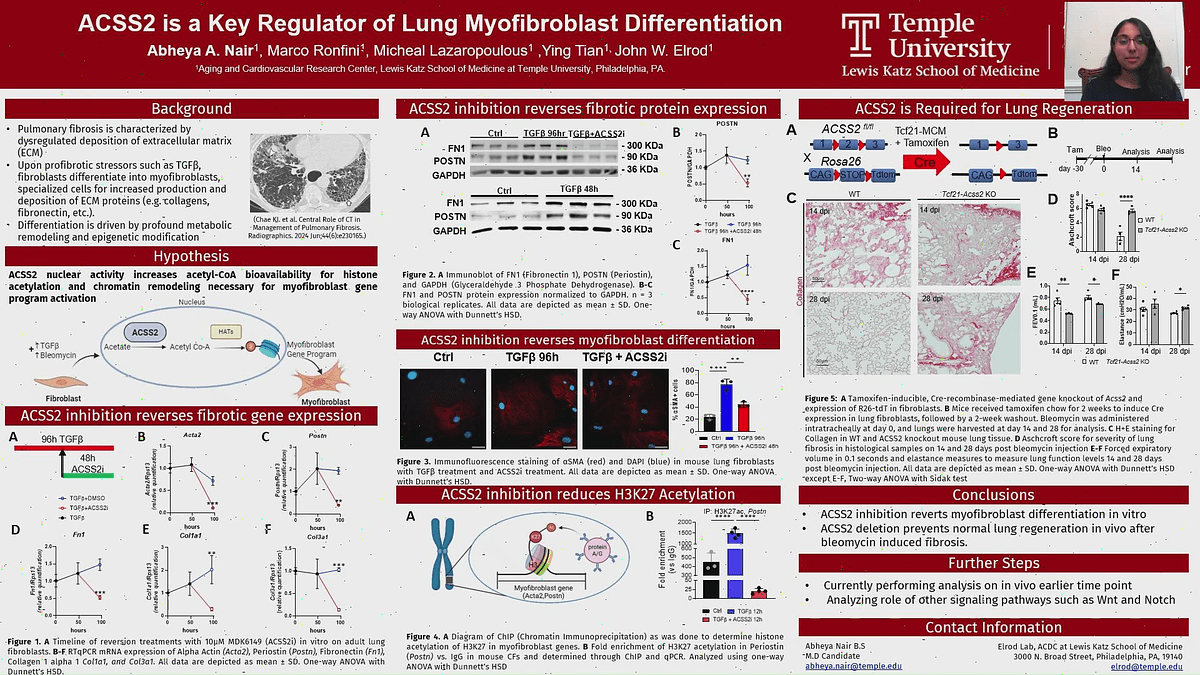
Background Pulmonary fibrosis is a pathological condition characterized by dysregulated deposition of extracellular matrix (ECM) that stiffens lung tissue and prevents proper lung expansion, and oxygen diffusion. Upon stressors like mechanical stress and profibrotic cytokines such as TGFβ, fibroblasts differentiate into myofibroblasts, which are specialized cells for increased production and deposition of ECM proteins (e.g. collagens, fibronectin, etc.). During differentiation, myofibroblasts undergo a profound metabolic remodeling, with upregulated glycolysis, glutaminolysis and reduced citric acid cycle flux. The resulting metabolites form co-factors necessary for epigenetic modification, such as histone acetylation, leading to the activation of the fibrotic gene program. Acetyl-CoA synthetase 2 (ACSS2) is a cytosolic and nuclear enzyme that synthesizes the metabolite acetyl-CoA from acetate, resulting in histone acetylation and gene activation. We hypothesize that ACSS2 is necessary to activate and maintain myofibroblast differentiation. Methods In vitro, differentiation of primary mouse lung fibroblasts was activated by TGFβ (10ng/mL) to induce the fibrotic gene program and treated with a drug inhibitor of ACSS2 (MDK6149, 10µM). In vivo studies were performed in a quiescent fibroblast-specific Acss2 knockout mouse model (Tcf21-Acss2 KO) and WT aged match controls. Lung fibrosis was induced by intratracheal injection of bleomycin. Histological and functional analyses (eg. FEV0.1 and elastance) were performed at 14 days (peak of fibrosis) and 28 days (resolution of fibrosis) post bleomycin injection. ECM gene expression was assessed using RT-qPCR, Western Blot, and Immunofluorescence. Specific fibrotic gene histone acetylation was determined through Chromatin Immunoprecipitation in TGFβ treated and untreated primary lung fibroblasts. Results ACSS2 inhibition significantly decreased specific fibrotic gene histone acetylation, inhibiting myofibroblast differentiation in vitro. Notably, pharmaceutical inhibition of ACSS2 resulted in reversion of differentiation after or, even during continuous TGFβ stimulation. In vivo, while at 14 days Tcf21-Acss2 KO lungs showed a mild decrease in fibrosis, at 28 days these lungs showed a lack of fibrosis resolution. Such continued fibrosis correlated with increased elastance and decreased FEV0.1 compared to wild type. Conclusion Our data shows that ACSS2 is a key regulator of in vitro myofibroblast differentiation and persistence. In vivo, ACSS2 expression in lung fibroblasts is necessary for normal lung regeneration after bleomycin-induced fibrosis. Our preliminary data shows that targeting ACSS2 in lung fibroblasts is a promising target to treat and reverse pulmonary fibrosis.

Downloads

Transcript English (automatic)

Next from 2025 AMA Research Challenge – Member Premier Access

Exploiting Lysosomal Lipolysis to Prevent Doxorubicin Cardiotoxicity

Exploiting Lysosomal Lipolysis to Prevent Doxorubicin Cardiotoxicity

2025 AMA Research Challenge – Member Premier Access

Yoonje Cho

22 October 2025