Would you like to see your presentation here, made available to a global audience of researchers?
Add your own presentation or have us affordably record your next conference.
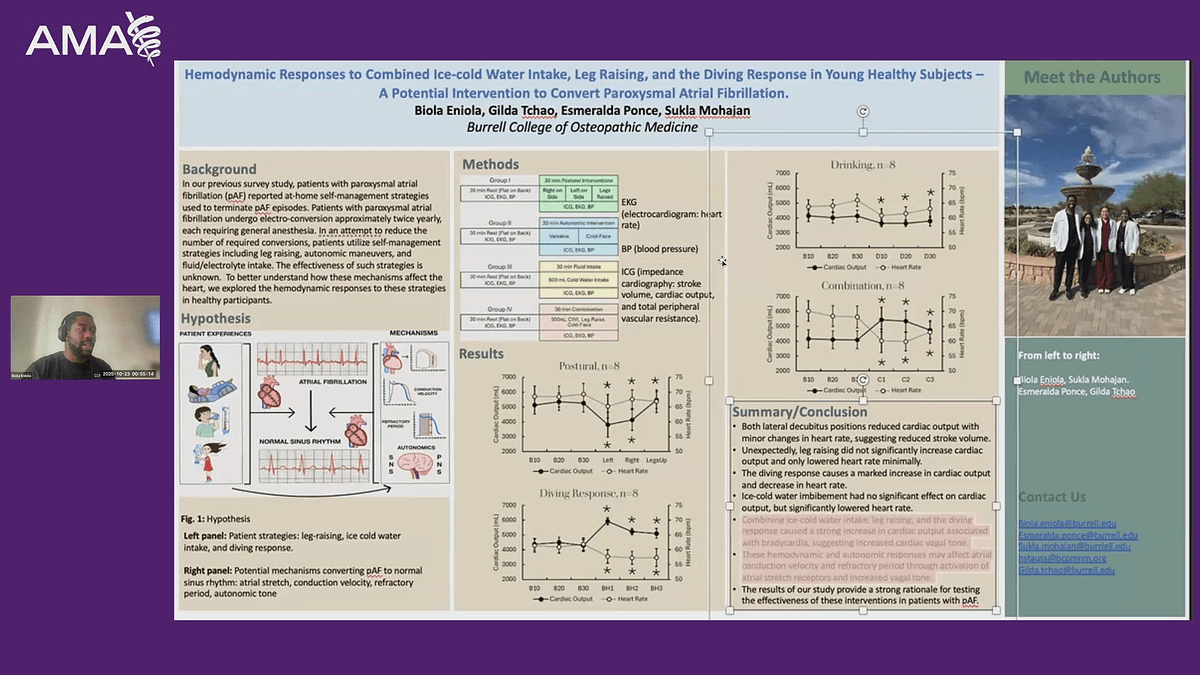
Hemodynamic responses to combined ice-cold water intake, leg raising, and the diving response in young healthy subjects – A potential intervention to convert paroxysmal atrial fibrillation.
Biola Eniola, Sukla Mohajan, Esmeralda Ponce, Gilda Tchao
Background: Patients with paroxysmal atrial fibrillation undergo electro-conversion approximately twice yearly, each requiring general anesthesia. In an attempt to reduce the number of required conversions, patients utilize self-management strategies including leg raising, autonomic maneuvers, and fluid/electrolyte intake. The effectiveness of such strategies is unknown. We explored the hemodynamic responses to these strategies in healthy participants. Methods: The study was approved by the Institutional Review Board of Burrell College and all young healthy volunteers (n=15, 3♂) provided written informed consent. Exclusion criteria: Pregnancy/nursing; chronic or acute conditions; use of prescription medications except contraceptives. Some subjects participated in multiple sessions separated by at least two days. A 30-minute baseline recording (supine position) was followed by 10 minutes with legs raised by 20 cm (group 1); three inspiratory breath holds while wearing an ice-cold face mask (diving response, group 2); 30 minutes of recording following 500 mL ice-cold water imbibement (group 3); or a combination of these interventions (group 4). Stroke volume was obtained by impedance cardiography, heart rate was derived from the ECG, blood pressure was recorded by finger plethysmography. Data are presented as means±standard error of the mean. Statistics were calculated by one-way analysis of variance. Results: Systolic blood pressure increased with leg raising (121.9±4.0 mmHg at baseline vs. 139.4±7.2 mmHg, n=8, P=0.06), the diving response (121.9±3.0 mmHg at baseline vs. 136.1±5.0 mmHg, n=8, P=0.01), and ice-cold water imbibement (123.4±3.8 mmHg at baseline vs. 137.2±6.5 mmHg, n=8, P=0.03), but not for the combination of the three interventions (122.1±5.4mmHg at baseline vs.116.9±4.9mmHg, n=8, P= 0.16). Heart rate decreased in response to all interventions, with the most pronounced bradycardic response observed with the combination of the three interventions (68.8±3.5bmp at baseline vs 61.1±3.4bmp, n=8, P=0.01). The diving response increased stroke volume (68.6±6.6 mL at baseline vs. 94.4±10.2 mL, n=8, P=0.06) and cardiac output (4.2±0.4 L at baseline vs. 5.4±0.6 L, n=8, P=0.11). Likewise, the combination of all three interventions (group 4) increased stroke volume (59.1±6.8mL at baseline vs. 84.3±9.8 mL, n=8, P=0.01) and cardiac output (4.1±0.6 L at baseline vs. 5.2±0.7 L, n=8, P=0.03). Conclusion: The combined application of ice-cold water imbibement, leg raising, and diving response elicited stronger hemodynamic responses than the individual interventions. The hemodynamic responses to the combined interventions are consistent with increased atrial stretch and cardiac autonomic modulation through baroreceptor and cardiopulmonary reflex responses. Whether these mechanisms can convert paroxysmal atrial fibrillation to sinus rhythm remains to be determined.