2025 AMA Research Challenge – Member Premier Access

October 22, 2025

Virtual only, United States

Would you like to see your presentation here, made available to a global audience of researchers?
Add your own presentation or have us affordably record your next conference.

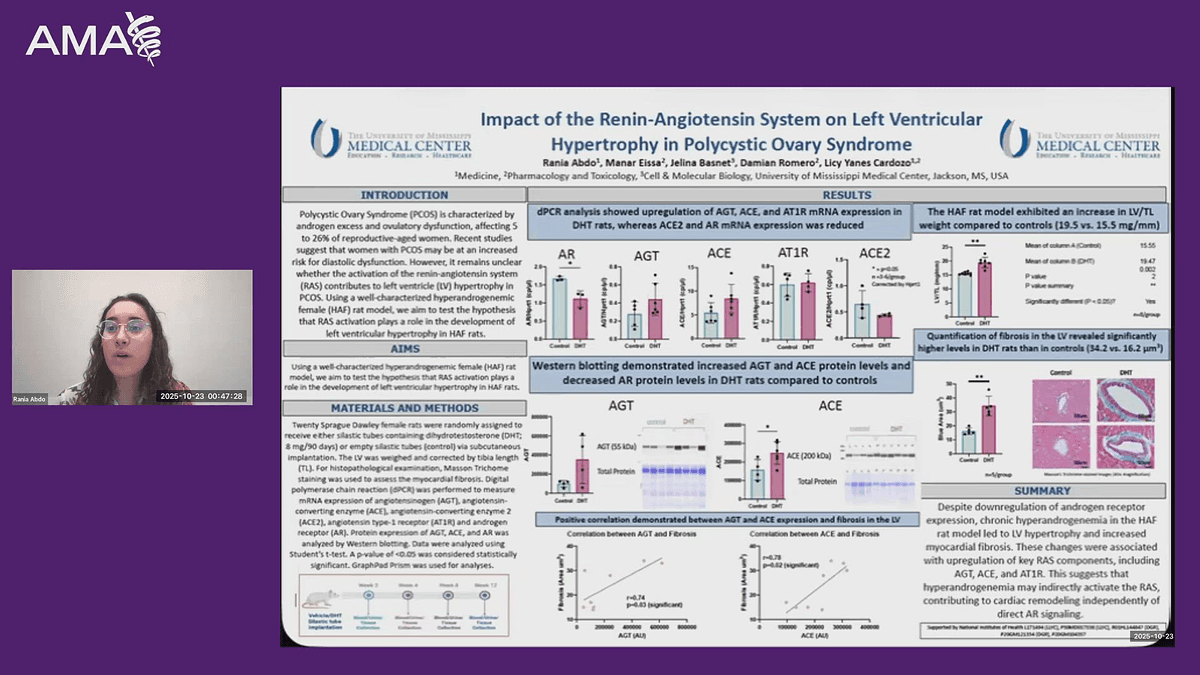
Abstract Title: Impact of the Renin-Angiotensin System on Left Ventricular Hypertrophy in Polycystic Ovary Syndrome

Background: Polycystic Ovary Syndrome (PCOS) is characterized by androgen excess and ovulatory dysfunction, affecting 5 to 26% of reproductive-aged women. Recent studies suggest that women with PCOS may be at an increased risk for diastolic dysfunction. However, it remains unclear whether the activation of the renin-angiotensin system (RAS) contributes to left ventricle (LV) hypertrophy in PCOS. Using a well-characterized hyperandrogenemic female (HAF) rat model, we aim to test the hypothesis that RAS activation plays a role in the development of left ventricular hypertrophy in HAF rats.

Methods: Twenty Sprague Dawley female rats were randomly assigned to receive either silastic tubes containing dihydrotestosterone (DHT; 8 mg/90 days) or empty silastic tubes (control) via subcutaneous implantation. The LV was weighed and corrected by tibia length (TL). For histopathological examination, Masson Trichome staining was used to assess the myocardial fibrosis. Digital polymerase chain reaction (dPCR) was performed to measure mRNA expression of angiotensinogen (AGT), angiotensin-converting enzyme (ACE), angiotensin-converting enzyme 2 (ACE2), angiotensin type-1 receptor (AT1R) and androgen receptor (AR). Protein expression of AGT, ACE, and AR was analyzed by Western blotting. Data were analyzed using Student’s t-test. A p-value of <0.05 was considered statistically significant. GraphPad Prism was used for analyses.

Results: The HAF rat model exhibited an increase in LV/TL weight compared to controls (19.5 vs. 15.5 mg/mm). Quantification of fibrosis in the LV revealed significantly higher levels in DHT rats than in controls (34.2 vs. 16.2 μm³). dPCR analysis showed upregulation of AGT, ACE, and AT1R mRNA expression in DHT rats, whereas ACE2 and AR mRNA expression was reduced. Consistently, Western blotting demonstrated increased AGT and ACE protein levels and decreased AR protein levels in DHT rats compared to controls.

Conclusion: Despite downregulation of androgen receptor expression, chronic hyperandrogenemia in the HAF rat model led to LV hypertrophy and increased myocardial fibrosis. These changes were associated with upregulation of key RAS components, including AGT, ACE, and AT1R. This suggests that hyperandrogenemia may indirectly activate the RAS, contributing to cardiac remodeling independently of direct AR signaling.

Downloads

Transcript English (automatic)

Next from 2025 AMA Research Challenge – Member Premier Access

Extracellular-cAMP Suppresses Pulmonary Hypertension-induced Ventricular Arrhythmias

Extracellular-cAMP Suppresses Pulmonary Hypertension-induced Ventricular Arrhythmias

2025 AMA Research Challenge – Member Premier Access

Shestruma Parajuli
Shestruma Parajuli

22 October 2025