keywords:
computer-based experiment
social cognition
computational modeling
development
psychology
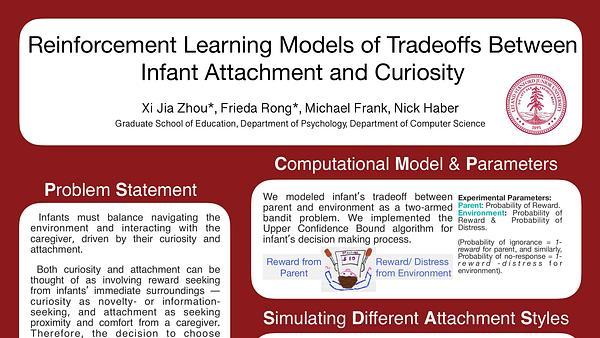
Infants’ attachment to their caregivers is a central feature of their early social and emotional development. Attachment Theory posits that these relationships vary systematically across distinct styles, though there has been debate about the extent to which these differences reflect features of caregivers’ responsiveness vs. infants’ own temperament. We develop a simple reinforcement learning model of infant exploration that allows us to vary the characteristics of simulated infants and caregivers and analyze the resulting patterns of model behavior. A set of equilibria reliably emerges that corresponds qualitatively to canonical attachment styles; particular agents’ equilibria are controlled by both caregiver and infant parameters. These simulations point the way towards a quantitative synthesis of prior theoretical debates about the nature of attachment.