Premium content
Access to this content requires a subscription. You must be a premium user to view this content.

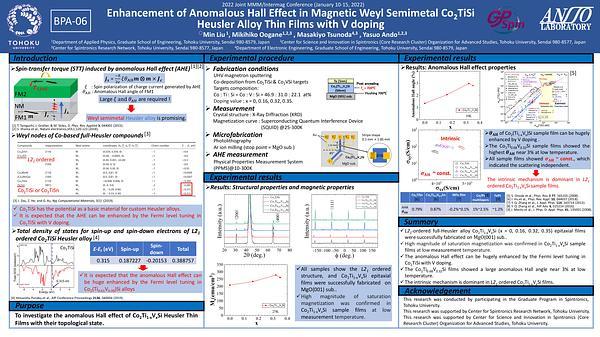
Recently, Co2TiSi Heusler alloy is theoretically predicted that is one of the ferromagnetic Weyl semimetal (WSM) candidates, and also the half-metal (1, 2, 3), which has potential for both a large anomalous Hall effect (AHE) and a large spin polarization. It is also expected that the anomalous Hall effect can be enhanced by customizing Co2(Ti1-xVx)Si due to the Fermi level shift (4, 5). In this research, we optimized the fabrication conditions for producing Co2(Ti1-xVx)Si thin films, and investigated their AHE and anisotropic magnetoresistance (AMR) effect to discuss the electronic structure in Co2(Ti1-xVx)Si.
The UHV magnetron co-sputtering method was used for the preparation of thin films using Co2TiSi and Co2VSi targets. The structure of the sample was MgO (001) sub. / Co2(Ti1-xVx)Si (50 nm) / Ta (5 nm), and the doping amount of x was changed. We characterized the crystal structure, magnetic properties, AHE and AMR effect by XRD, SQUID, and PPMS, respectively.
High quality L21 ordered single crystal films (SL21 ≈ 70%) were successfully fabricated by applying adequate annealing process. Fig. 1 shows doping value x dependence of anomalous Hall angle (AHA), measured at 10 K. AHA of Co2(Ti1-xVx)Si sample films enhanced by V doping, and the highest AHA was observed near 3% at x = 0.31. Fig. 2 shows measurement temperature dependence of AMR radio when the electric current flowed in the Co2(Ti1-xVx)Si 110 and 100 directions. The magnitude of AMR ratio increases with decreasing temperature for both directions, but the sign is positive for 110 and negative for 100 direction, respectively. The s-d scattering theory of AMR (6) suggests that d-orbitals of majority spin electron are split by crystal field and the density of states of ε- and γ-orbitals are well different at the Fermi level. The change of magnitude of AMR for 100 direction implies that the Fermi level tuning was realized by V doping into the Co2TiSi Heusler alloy thin films.
This research was conducted by participating in the GP-Spin and JST's SPRING program, Tohoku University, and supported by CSIS Organization for Advanced Studies and the CSRN.
References:
(1) A. Bernevig, H. M. Weng, Z. Fang and X. Dai, J. Phys. Soc. Jpn., 87, 041001 (2018).
(2) G. Q. Chang, S. Y. Xu, H. Zheng et al., Sci. Rep. 6. 38839; doi: 10.1038/srep38839 (2016).
(3) J. Barth, G. H. Fecher, B. Balke et al., Phys. Rev. B 81, 064404 (2010).
(4) J. Zou, Z. He, and G. Xu, Npj Computational Materials, 5(1) (2019).
(5) I. Galanakis, P. H. Dederichs, and N. Papanikolaou, Phys. Rev. B 66, 174429 (2002).
(6) S. Kokado and M. Tsunoda, J. Phys. Soc. Jpn. 88, 034706 (2019).