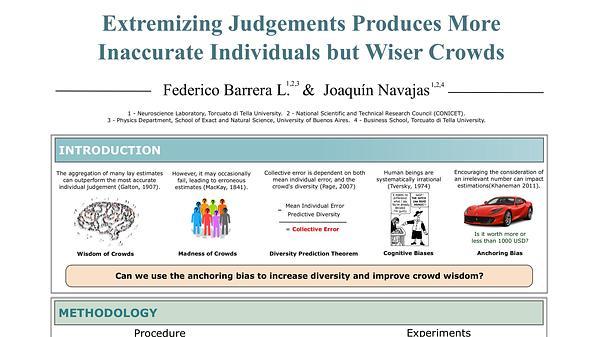
How can groups become wise when individuals interact, deliberate, or disagree? In this talk, I present findings from three lines of research examining collective wisdom in convergent and divergent crowds. First, I show evidence that averaging the consensus estimates of a small number of deliberating groups can outperform the aggregation of many independent individuals. Second, I present recent work showing that deliberative crowds become wiser when they break problems into meaningful subcomponents using Fermi-like reasoning and set aside their initial opinions. This approach reduces collective error, whereas simply exchanging and combining individual estimates increases it. Finally, I turn to the opposite case and examine what happens when people diverge toward extreme and polarized opinions. I show that experimentally inducing erroneous opposing opinions increases individual error but can improve collective accuracy by increasing the diversity of judgments. Together, these findings suggest that the efficiency of social cooperation depends on how groups structure convergence and disagreement. More broadly, they highlight that the relationship between individual biases and collective performance is neither obvious nor intuitive. Polarization and other distortions that reduce individual accuracy can sometimes improve collective judgments, whereas convergence and finding middle ground may undermine them.