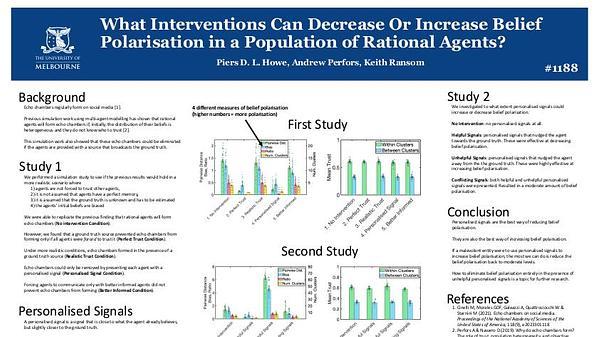
Do biased minds or sources cause issue polarisation? Demand-side accounts emphasise motivated reasoning where people selectively attend to, and favourably evaluate, attitude-consistent information. Supply-side accounts emphasise the information environment, such as ideologically committed sources. We present an agent-based model to test if motivated reasoning mechanisms can create polarisation without biased information sources. Our simulations suggest that populations converge to consensus, regardless of motivated reasoning strength. Polarisation only emerges given ideological broadcasters. Critically, pre-polarised populations converge without persistent biased sources, indicating that motivated reasoning does not maintain existing polarisation. We also find that selective exposure counterintuitively reduces polarisation from consensus by symmetrically filtering all extreme sources. These results support a supply-side thesis: within the logic of the model, motivated reasoning mechanisms were not sufficient for belief polarisation without biased information sources. Here, motivated reasoning and echo chambers are amplifiers, not generators, of issue polarisation.