keywords:
archival tag
tuna
bioenergetics
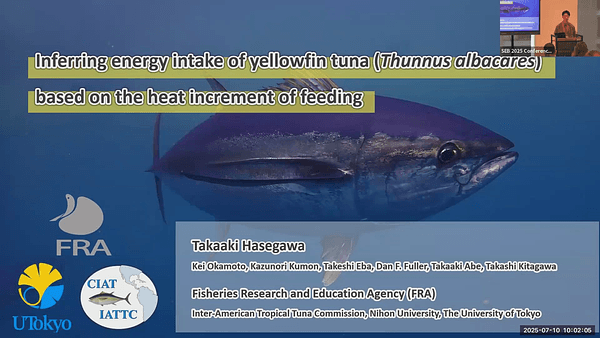
Spatial heterogeneity in energy acquisition of marine animals shapes regional variation in demographic processes and has important implications for conservation and management. However, quantifying energy intake in large pelagic predators and evaluating its broad-scale spatial structure remain extremely challenging. Here, we examined the spatial distribution of energy intake in yellowfin tuna (Thunnus albacares) across the tropical Pacific Ocean by coupling archival tagging data with a geostatistical model. We first conducted a feeding experiment to establish the relationship between the heat increment of feeding and ingested energy in yellowfin tuna using archival tags. This relationship was then applied to archival tagging data from wild fish to estimate their field energy intake. Our results indicated a clear difference in energy intake, with higher values observed in the eastern Pacific Ocean (EPO) compared to the western Pacific Ocean (WPO). Thermocline depth had a significant negative effect on foraging probability, indicating that feeding was more likely in regions with a shallower thermocline. Model-based predictions showed a consistent eastward increase in mean energy intake, with values in the EPO reaching approximately 2.5 times those in the WPO. These results suggest that strong east–west contrasts in oceanographic structure across the tropical Pacific Ocean systematically shape feeding opportunities and energy acquisition in yellowfin tuna. Our findings provide physiological insight into mechanisms driving spatial variation in key demographic processes such as growth, with important implications for conservation and management of this commercially important species in a changing ocean.