keywords:
fatigability
critical intensity
force-velocity relationship
locomotion
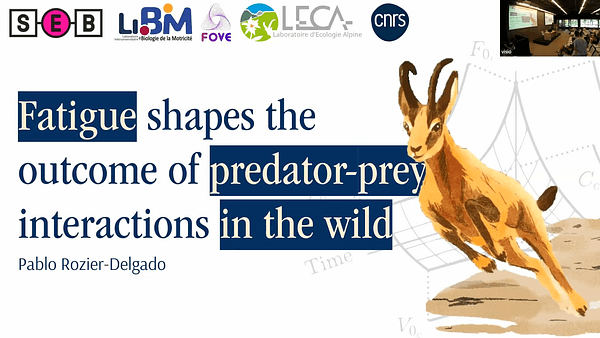
The capacities to move fast and over long durations are primary determinants of animal survival. Complex environments as steep terrains or high-acceleration escape manoeuvres further challenge locomotion by demanding high propulsive force capacities to overcome elevation or inertia. Based on the force-velocity relationship characterising an individual's maximal propulsive capacities, we propose a theoretical Force-Velocity-Endurance (FoVE) model that integrates fatigue resistance and propulsive capacities during long-duration efforts. FoVE profiling could connects physiological limits to spontaneous behaviour and illustrates how selective pressures like steep gradients drives the evolution of force-oriented endurance. Because laboratory testing is infeasible for wild species, humans provide a unique paradigm to bridge controlled experiments and spontaneous field activity. FoVE profiles of 22 trail runners were derived from in natura GPS data using the record-profile method, and then used to predict critical velocities, sustainable over long durations, under various force constraints (weighted sledges). Predictions were compared against laboratory evaluations to test model accuracy. Results showed a strong correlation between field-derived and laboratory critical velocities across all force conditions (r=0.913; p<0.001), with moderate systematic and random errors (0.14 m.s-1 , 4.9%, and 0.41 m.s-1 , 14.4%, respectively). These findings demonstrate that field-based GPS data provide accurate FoVE profiles, turning the steps of human participants into a promising step forward for assessing locomotion capacities in wild mountain-dwelling animals. This framework was then applied exploratorily to Capra ibex, comparing their uphill capacities with human profiles. This illustrates how integrating force and endurance dimensions, often overlooked in animals, opens new possibilities in ecophysiology and evolution.