Would you like to see your presentation here, made available to a global audience of researchers?
Add your own presentation or have us affordably record your next conference.
Introduction
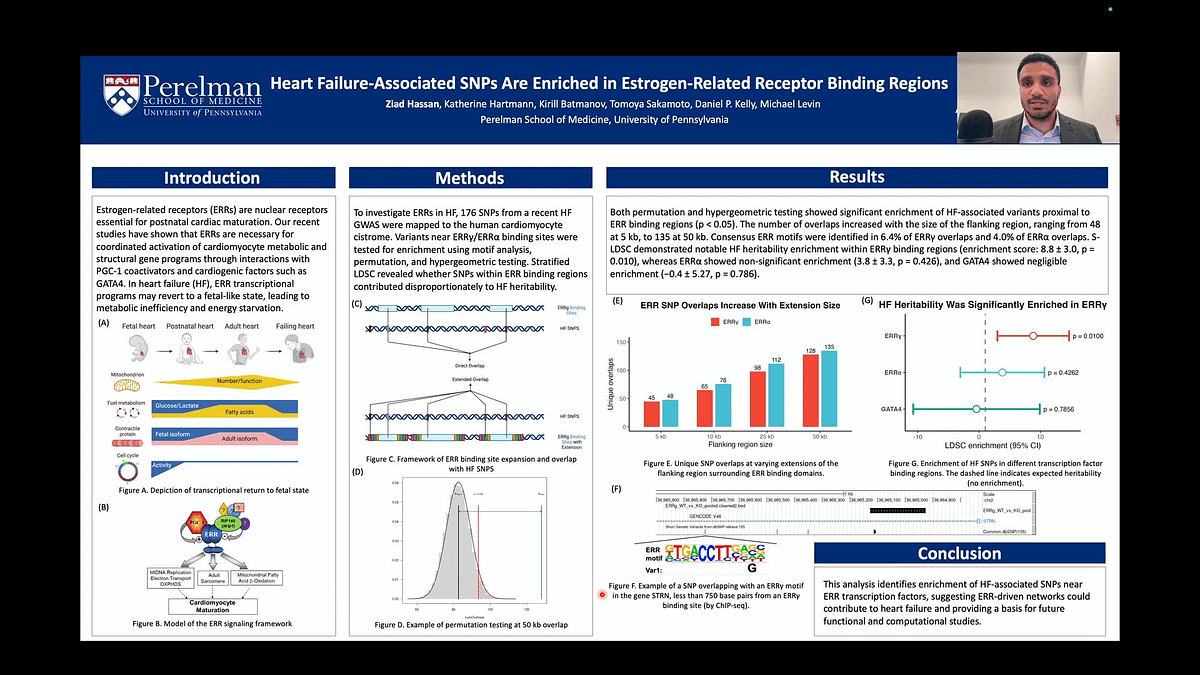
Estrogen-related receptors (ERRs) are nuclear receptors essential for postnatal cardiac maturation. Our recent studies have shown that ERRs are necessary for coordinated activation of cardiomyocyte metabolic and structural gene programs through interactions with PGC-1 coactivators and cardiogenic factors such as GATA4. In heart failure (HF), ERR transcriptional programs may revert to a fetal-like state, leading to metabolic inefficiency and energy starvation.
Methods
To better understand ERRs’ role in HF, 176 SNPs from a recent HF GWAS were mapped onto the human cardiomyocyte cistrome to identify potential HF-associated variants proximal to ERRγ and/or ERRα binding regions. Overlaps were analyzed for ERR binding motifs with an 80% position-weight matrix threshold. Permutation testing was performed to determine if HF-associated variants were found more frequently than expected near ERR binding regions. Hypergeometric testing assessed whether HF-associated SNPs were enriched in ERR binding regions compared to genome-wide SNPs, with per-chromosome p-values combined using Fisher’s method. Stratified linkage disequilibrium score regression (S-LDSC) was performed to quantify whether SNPs within ERR binding regions disproportionately contributed to HF heritability compared to genome-wide averages.
Results
Both permutation and hypergeometric testing showed significant enrichment of HF-associated variants proximal to ERR binding regions (p < 0.05). The number of overlaps increased with the size of the flanking region, ranging from 48 at 5 kb to 135 at 50 kb. Consensus ERR motifs were identified in 6.4% of ERRγ overlaps and 4.0% of ERRα overlaps. S-LDSC demonstrated notable HF heritability enrichment within ERRγ binding regions (enrichment score: 8.8 ± 3.0, p = 0.010), whereas ERRα showed non-significant enrichment (3.8 ± 3.3, p = 0.426), and GATA4 showed negligible enrichment (−0.4 ± 5.27, p = 0.786).
Conclusion
This computational analysis reveals significant enrichment of HF-associated SNPs in or near genomic regions containing ERR transcription factors, highlighting ERR-driven transcriptional networks as potentially important mechanisms underlying heart failure development. These results establish a platform for future functional experimental studies to determine the impact of HF-associated variants on ERR-mediated transcriptional regulatory function and additional computational analyses to clarify the precise biological roles of ERRs in HF progression.