2025 AMA Research Challenge – Member Premier Access

October 22, 2025

Virtual only, United States

Would you like to see your presentation here, made available to a global audience of researchers?
Add your own presentation or have us affordably record your next conference.

Background

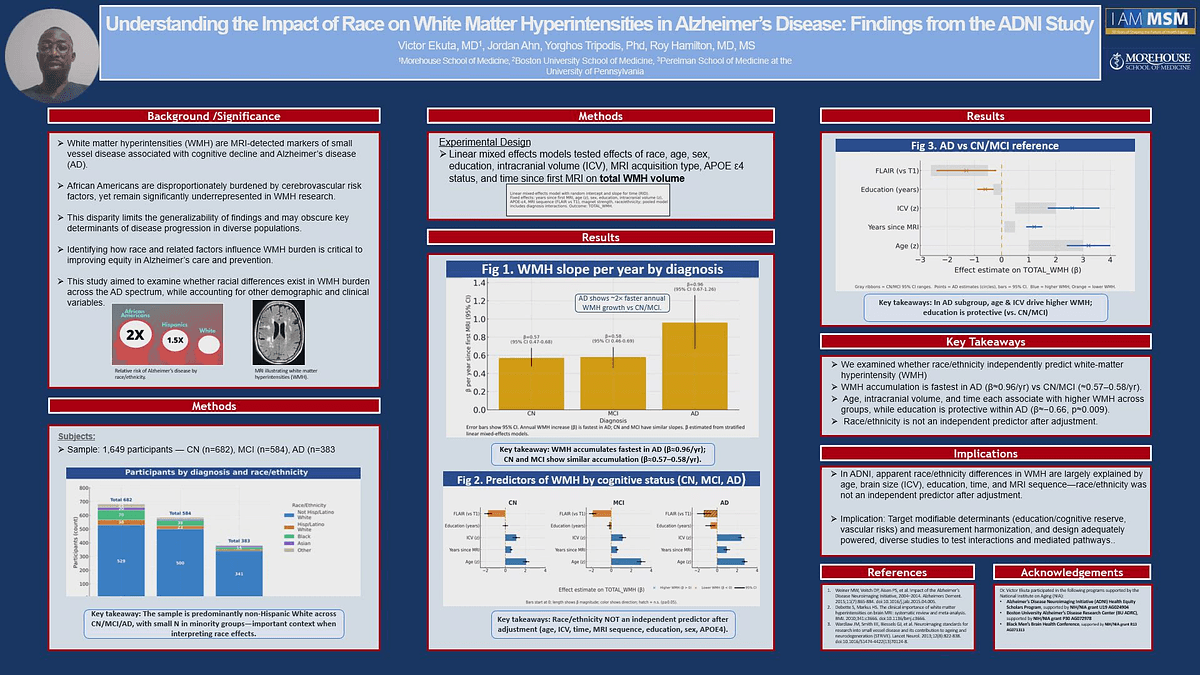
White matter hyperintensities (WMH) are MRI-detected markers of small vessel disease associated with cognitive decline and Alzheimer’s disease (AD). African Americans (AAs) are disproportionately burdened by cerebrovascular risk factors, yet remain significantly underrepresented in WMH research. This disparity limits the generalizability of findings and may obscure key determinants of disease progression in diverse populations. Identifying how race and related factors influence WMH burden is critical to improving equity in Alzheimer’s care and prevention. This study aimed to examine whether racial differences exist in WMH burden across the AD spectrum, while accounting for other demographic and clinical variables.

Methods

We analyzed cross-sectional MRI and clinical data from 1,649 participants in the Alzheimer’s Disease Neuroimaging Initiative (ADNI): 682 cognitively normal (CN), 584 with mild cognitive impairment (MCI), and 383 with AD. Of these, 124 participants (7.5%) identified as African American: CN (n=70), MCI (n=39), and AD (n=15). Linear mixed effects models were used to evaluate the effect of race, cognitive status, time since first MRI, age, sex, education, intracranial volume (ICV), MRI acquisition type, and APOE ε4 status on total WMH volume.

Results

Older age, greater time since MRI, and larger ICV were significantly associated with increased WMH burden across cognitive groups. Use of FLAIR imaging was negatively associated with WMH volume, reflecting differences in image acquisition sensitivity. Higher educational attainment was linked to lower WMH burden, suggesting a possible neuroprotective effect. The most pronounced associations were observed within the AD subgroup. After adjusting for all covariates, race was not a statistically significant independent predictor of WMH burden.

Conclusion

Although race did not independently predict WMH burden, other structural and demographic factors, including age, education level, and MRI technique, significantly influenced WMH volume. These findings highlight the complex interplay between biological, social, and technical variables in shaping cerebrovascular brain aging. Greater inclusion of African American participants in future studies is essential to better understand race-related mechanisms and to design interventions that equitably address WMH accumulation and its cognitive consequences.

Downloads

Transcript English (automatic)

Next from 2025 AMA Research Challenge – Member Premier Access

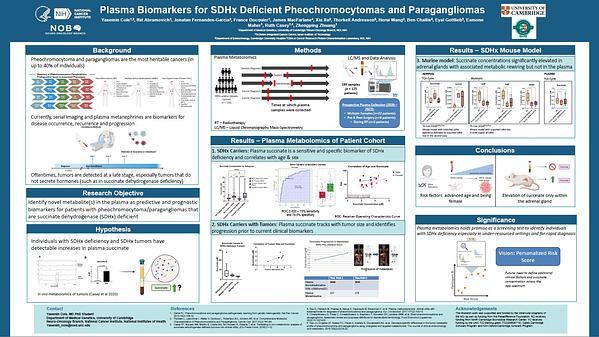
Plasma Biomarkers for SDHx Deficient Pheochromocytomas and Paragangliomas

Plasma Biomarkers for SDHx Deficient Pheochromocytomas and Paragangliomas

2025 AMA Research Challenge – Member Premier Access

Yasemin Cole
Yasemin Cole

22 October 2025