2025 AMA Research Challenge – Member Premier Access

October 22, 2025

Virtual only, United States

Would you like to see your presentation here, made available to a global audience of researchers?
Add your own presentation or have us affordably record your next conference.

Background

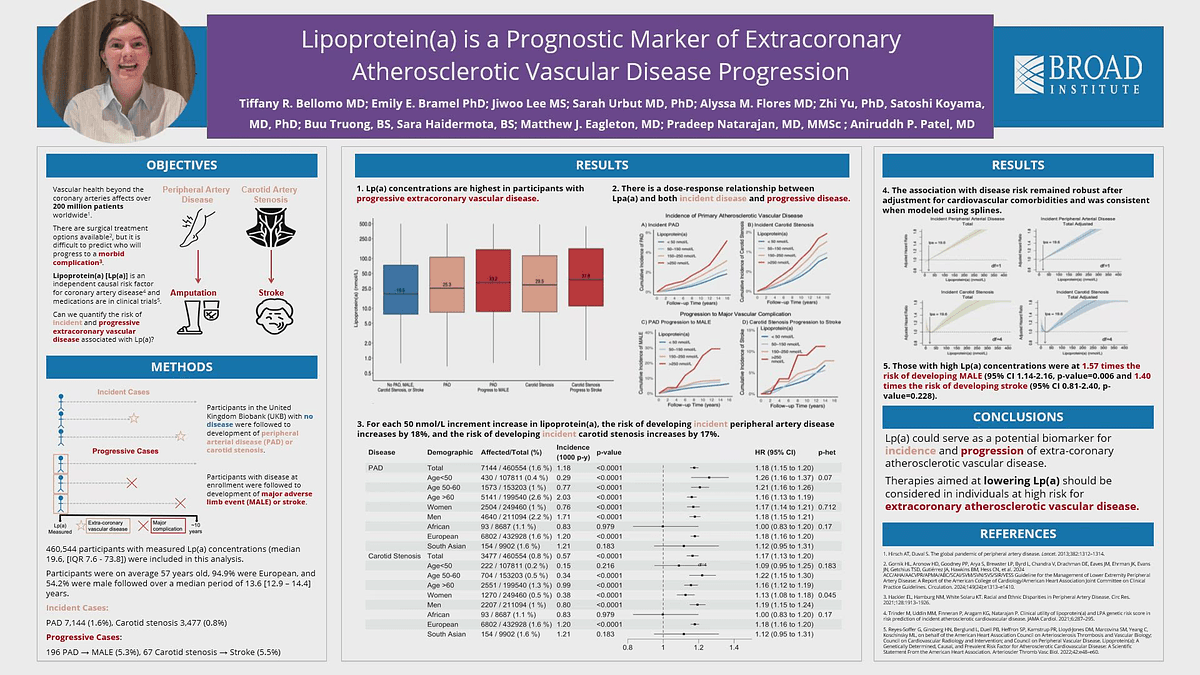
Despite current treatment strategies for atherosclerotic vascular disease focusing on lifestyle modification and lowering cholesterol, a significant residual risk of major atherosclerotic complication remains, prompting investigation into lipoprotein(a) Lp(a) as a potential predictive biomarker. The objective of this study was to determine the utility of Lp(a) in identifying patients at high risk of incident extracoronary atherosclerotic vascular disease and complications.

Methods

Data from 460,544 participants in the UK Biobank with prospectively measured Lp(a) concentrations were included in this analysis. Cox proportional hazards regressions modeled the associations of Lp(a) concentrations with incident peripheral arterial disease (PAD) and incident carotid artery stenosis, and progression to the first major adverse limb event (MALE) and the first stroke, respectively.

Results

Of the study participants, the median IQR age at study enrollment was 58 51 – 64 years, 54.2% were male, 94.4% European, 5.5% had diabetes, and 10.5% were smokers. Over a median follow-up time of 13.6 12.9 – 14.4 years, 6,347 (1.4%) and 1,972 (0.43%) developed the first incidence of PAD and carotid stenosis, respectively. Among participants with prevalent PAD and carotid stenosis at enrollment, 196 (2.7%) and 67 (1.9%) progressed to the first incidence of MALE and stroke, respectively. Median Lp(a) concentrations were significantly different in those without atherosclerotic vascular disease at 19.5 nmol/L 7.6-73.5 compared to incident PAD at 25.3 nmol/L 8.3-107.3, progression to MALE at 33.3 nmol/L 8.7-158.2, incident carotid stenosis at 29.5 nmol/L 8.5-116.3, and carotid stenosis progression to stroke at 37.8 nmol/L 11.1-158.3. The risk estimate per 75 nmol/L Lp(a) for incident PAD (HR 1.18, 95% CI 1.15-1.20, p-value<0.0001) was similar to incident carotid stenosis (HR 1.17, 95% CI 1.13-1.20, p-value<0.0001). Among participants with PAD, those with high Lp(a) concentrations were at 1.57 times the risk of developing MALE than participants with normal Lp(a) concentrations (95% CI 1.14-2.16, p-value=0.006). Among participants with carotid stenosis, participants had 1.40 times the risk of developing an ischemic stroke with high Lp(a) concentrations, although this was not significant (95% CI 0.81-2.40, p-value=0.228).

Conclusion

High concentrations of Lp(a) are associated with both incident extracoronary atherosclerotic vascular disease and progression to major complications.

Downloads

Transcript English (automatic)

Next from 2025 AMA Research Challenge – Member Premier Access

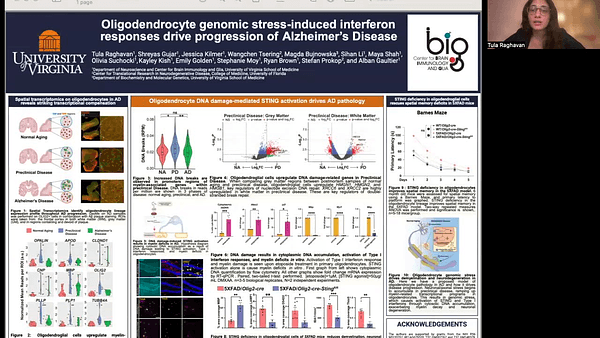
Oligodendrocyte genomic stress-induced interferon responses drive progression of Alzheimer’s Disease

Oligodendrocyte genomic stress-induced interferon responses drive progression of Alzheimer’s Disease

2025 AMA Research Challenge – Member Premier Access

Tula Raghavan

22 October 2025