2025 AMA Research Challenge – Member Premier Access

October 22, 2025

Virtual only, United States

Would you like to see your presentation here, made available to a global audience of researchers?
Add your own presentation or have us affordably record your next conference.

Background

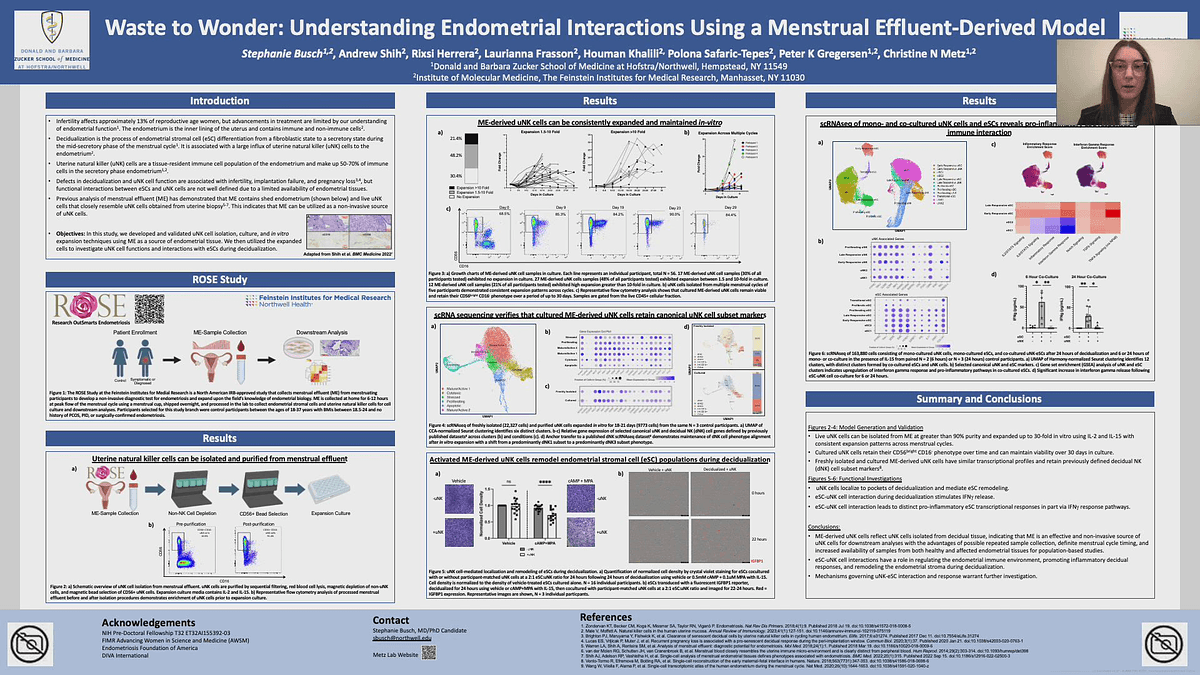
Infertility is a rising health concern that affects approximately 13% of reproductive age women, but advancements in treatment are limited by our understanding of endometrial function. Decidualization is the process of endometrial stromal cell (eSC) differentiation from a fibroblastic state to a secretory state that occurs during the mid-secretory phase of the menstrual cycle and is associated with a dramatic influx of uterine natural killer (uNK) cells to the endometrium. Defects in decidualization and uNK cell function are associated with infertility, implantation failure, and pregnancy loss, but mechanisms of eSC-uNK cell interaction are not well defined. In this study, we developed and validated uNK cell isolation and expansion techniques using menstrual effluent (ME) as a source of endometrial tissue, then used these ME-derived uNK cells to investigate interactions between uNK cells and decidualizing eSCs to further understand cellular processes occurring prior to embryo implantation.

Methods

ME samples were collected from participants of the Research OutSmarts Endometriosis (ROSE) study at the Feinstein Institutes for Medical Research. uNK cells were purified by sequential magnetic isolations and expanded in vitro using IL-15 and IL-2. These ME-derived uNK cells were transcriptionally verified by scRNAseq and compared to reference datasets. For co-culture experiments, eSC decidualization was induced by cAMP + MPA. Interactions between uNK cells and decidualizing eSCs were characterized by live-imaging microscopy, eSC staining, and scRNAseq. Functional mechanisms of uNK-eSC interaction were described by protein and gene expression using ELISA and qPCR analyses.

Results

This novel uNK cell isolation method achieved a purity of up to 92% CD56bright CD16- uNK cells. Cultured ME-derived uNK cells exhibited up to 30-fold expansion, maintained viability for approximately 30 days, and retained phenotypes of reference decidua-derived uNK cells as assessed by flow cytometry and single cell RNA sequencing. In an ME-derived model of uNK-eSC interaction, uNK cells mediated contact-dependent eSC remodeling during decidualization as determined by live-imaging microscopy and cell density analysis. uNK cells concurrently stimulated a pro-inflammatory eSC response in part via IFN release as determined by transcriptomic and proteomic analysis.

Conclusion

These results indicate that ME is a viable, non-invasive source of uNK cells that can be used for downstream analyses and suggest that uNK cells mediate both eSC remodeling and inflammation during decidualization. Interactions between uNK cells and eSCs are critical for endometrial receptivity, and this novel ME-derived system greatly expands the available tools to investigate mechanisms contributing to endometrial homeostasis and female fertility.

Downloads

Transcript English (automatic)

Next from 2025 AMA Research Challenge – Member Premier Access

Leveraging Patient-Provided Data in the Electronic Health Record to Improve Care for Veterans

Leveraging Patient-Provided Data in the Electronic Health Record to Improve Care for Veterans

2025 AMA Research Challenge – Member Premier Access

Steven Lecates
Steven Lecates

22 October 2025