2025 AMA Research Challenge – Member Premier Access

October 22, 2025

Virtual only, United States

Would you like to see your presentation here, made available to a global audience of researchers?
Add your own presentation or have us affordably record your next conference.

Background

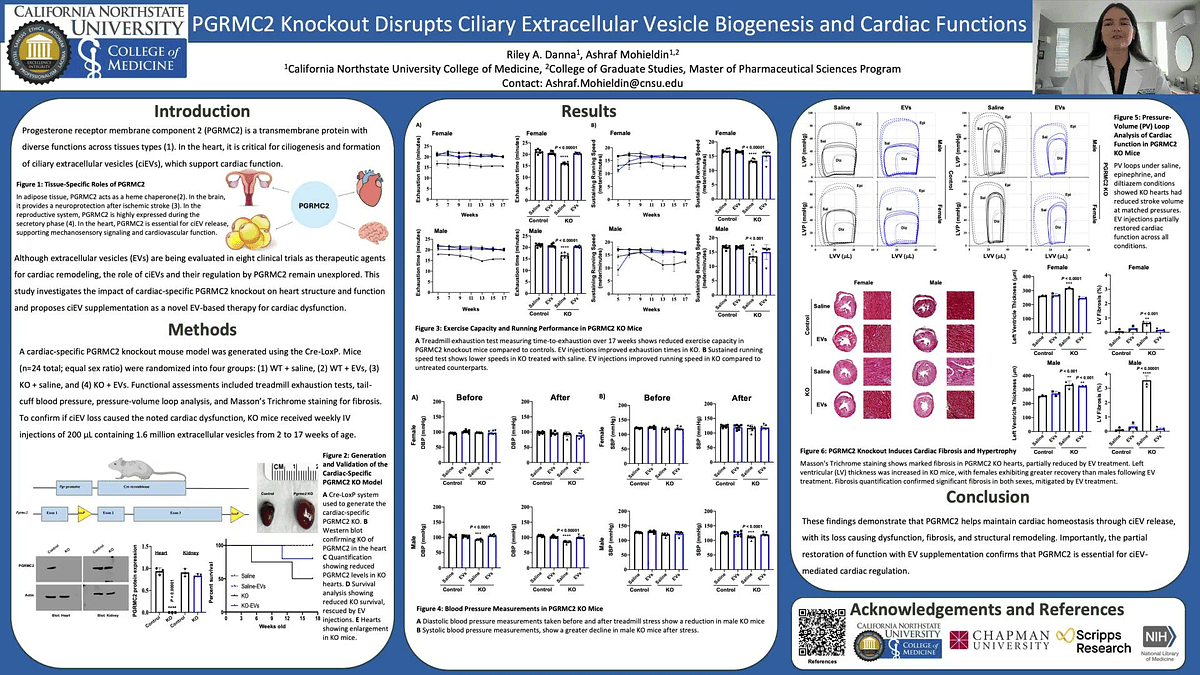
Progesterone receptor membrane component 2 (PGRMC2) is critical for ciliogenesis and the biogenesis of ciliary extracellular vesicles (ciEVs), which play an essential role in maintaining cardiac function. Extracellular vesicles (EVs) are currently being evaluated in eight clinical trials as therapeutic agents for cardiac remodeling. While these studies highlight the therapeutic promise of EVs, the role of ciEVs and their regulation via PGRMC2 remains largely unexplored. This study investigates the impact of cardiac-specific PGRMC2 knockout on heart structure and function and proposes ciEV supplementation as a novel strategy to target cardiac dysfunction, expanding the therapeutic potential of EV-based cardiac therapies.

Methods

A cardiac-specific PGRMC2 knockout (KO) mouse model was generated using the Cre-LoxP system to investigate the role of PGRMC2 in cardiac structure and function. Mice were randomized into four groups (n=24 total; equal sex ratio): (1) wild-type with saline, (2) wild-type with EV treatment, (3) KO with saline, and (4) KO with EV treatment. Starting at two weeks of age and continuing through 17 weeks, mice received weekly intravenous injections of either 200 µL saline or 1.6 million EVs. Assessments were conducted weekly and included treadmill exercise testing and blood pressure measurements. At 18 weeks, cardiac tissue was collected for histological evaluation using Masson’s trichrome staining to assess fibrosis, and left ventricular wall thickness. Statistical significance was defined as P < 0.05.

Results

Survival analysis demonstrated a high mortality rate (50%) in knockout mice and treadmill exercise-stress tests revealed a marked reduction in exercise capacity (p<0.00001) in KO mice. Blood pressure analysis showed a greater decline in diastolic (p<0.0001 before exercise; p<0.00001 after exercise) and systolic (p<0.0001 after exercise) blood-pressure in male KO mice compared to females. Pressure-volume (PV) loop analysis assessed cardiac performance under baseline (saline), increased workload (epinephrine), and reduced workload (diltiazem) conditions. KO mice exhibited reduced stroke-volume, indicating impaired cardiac output and efficiency. Histological analysis revealed left ventricular hypertrophy (p<0.0001 female; p<0.001 male) and a significant increase in cardiac fibrosis (p<0.001 female; p < 0.00001 male) in knockout mice. EV treatment significantly improved survival rate (75%), blood-pressure regulation, ventricular thickness, and cardiac fibrosis.

Conclusion

Loss of PGRMC2 disrupts ciEVs release, leading to structural and functional cardiac deterioration. Extracellular vesicle injections rescue these deficits, highlighting the essential role of ciEVs and PGRMC2 in maintaining cardiac homeostasis, further reinforcing their therapeutic potential.

Downloads

Transcript English (automatic)

Next from 2025 AMA Research Challenge – Member Premier Access

Rural-Urban Skin Cancer Prevention and Treatment Differences for Medicare Beneficiaries, 2019–2023

Rural-Urban Skin Cancer Prevention and Treatment Differences for Medicare Beneficiaries, 2019–2023

2025 AMA Research Challenge – Member Premier Access

Rishi Ray
Rishi Ray

22 October 2025