2025 AMA Research Challenge – Member Premier Access

October 22, 2025

Virtual only, United States

Would you like to see your presentation here, made available to a global audience of researchers?
Add your own presentation or have us affordably record your next conference.

Background

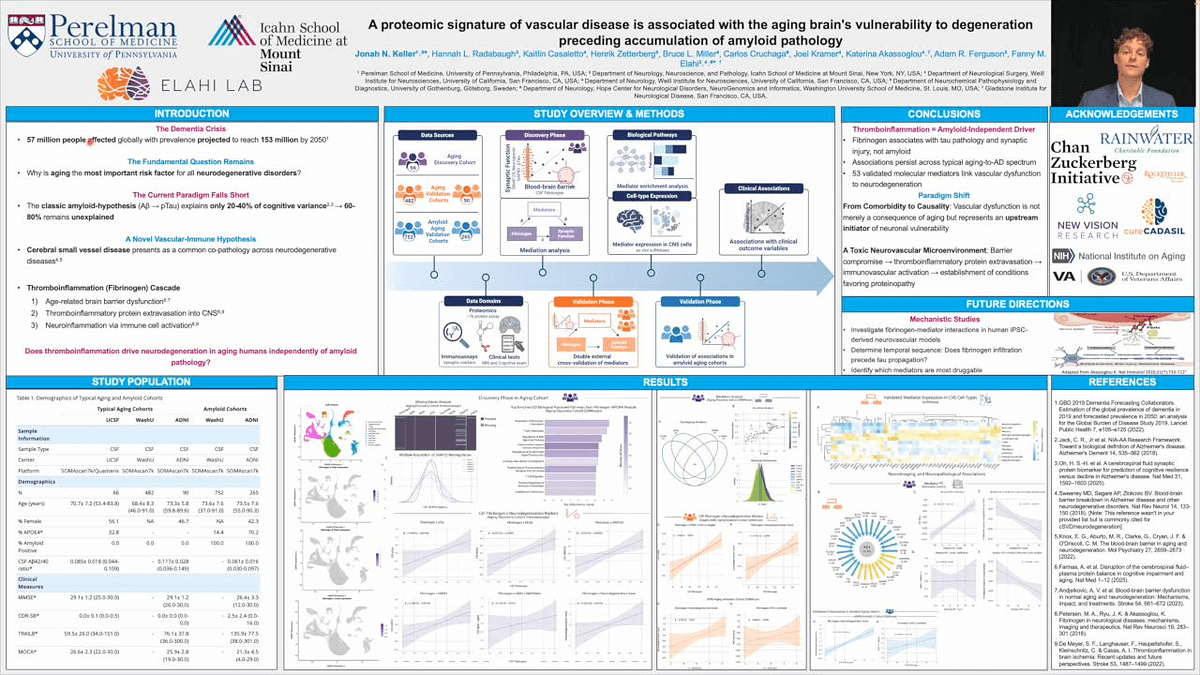
Aging confers the most significant risk for dementia, yet the underlying mechanisms remain poorly understood. While the amyloid cascade hypothesis has dominated the field for decades, a large proportion of variance in cognitive impairment remains unexplained by classical proteinopathies. Thromboinflammation—a vascular and immune signaling axis involving brain barrier dysfunction and protein extravasation—may represent an upstream initiator of neuronal vulnerability that precedes amyloid pathology. Recent work by our colleague shows fibrinogen, a peripheral coagulation protein, to exhibit one of the earliest age-related increases in cerebrospinal fluid, yet its role as a driver of brain degeneration in living humans remains unexplored.

Methods

We present the most comprehensive investigation of thromboinflammation as a driver of degenerative brain changes in aging living humans. We integrated high-dimensional cerebrospinal fluid proteomics (~7,000 proteins) across 1,655 individuals from three independent cohorts with single-cell transcriptomics, brain imaging, and cognitive data. Using CSF fibrinogen levels as a quantifiable marker of brain barrier dysfunction, we employed systematic mediation analysis to identify molecular pathways linking vascular compromise to synaptic vulnerability in amyloid-negative, cognitively typical older adults, with validation across independent cohorts and testing in amyloid-positive states.

Results

We identified a reproducible molecular network linking brain barrier dysfunction to white matter degeneration, synaptic loss, and cognitive slowing—well before amyloid pathology appears. Fibrinogen emerged as a central hub of brain aging biology, with higher CSF levels significantly associating with elevated markers of synaptic dysfunction (pTau181, neurogranin, GAP43, SNAP25) and cognitive slowing in amyloid-negative adults. We identified 53 validated molecular mediators of fibrinogen's neurotoxic effects, enriched in neurovascular unit cells and demonstrating coordinated dysregulation of angiogenesis, fibrosis, and immune signaling. These mediator signatures correlated with compromised white matter integrity in tracts critical for cognitive processing speed. Critically, fibrinogen associated with tauopathy independent of amyloid buildup, and these associations persisted robustly in amyloid-positive individuals while remaining independent of amyloid burden, demonstrating relevance across the neurodegeneration spectrum.

Conclusion

Our findings offer a paradigm-shifting answer to why aging confers powerful dementia risk by positioning thromboinflammation as an upstream initiator of neuronal vulnerability that challenges the prevailing temporal hierarchy of neurodegeneration. This work reframes vascular disease from comorbidity to causality, introducing a vascular-centered model of brain aging that bypasses classical proteinopathy models. The identified molecular mediators provide an upstream, druggable axis with immediate implications for biomarker development, clinical trial stratification, and brain healthspan-preserving interventions across the aging spectrum. "

Downloads

Transcript English (automatic)

Next from 2025 AMA Research Challenge – Member Premier Access

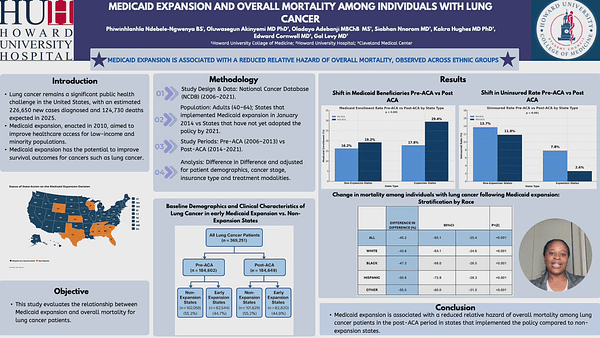
Medicaid Expansion and Overall Mortality among Individuals Living with Lung Cancer

Medicaid Expansion and Overall Mortality among Individuals Living with Lung Cancer

2025 AMA Research Challenge – Member Premier Access

Phiwinhlanhla Ndebele-Ngwenya

22 October 2025