Would you like to see your presentation here, made available to a global audience of researchers?
Add your own presentation or have us affordably record your next conference.
Background
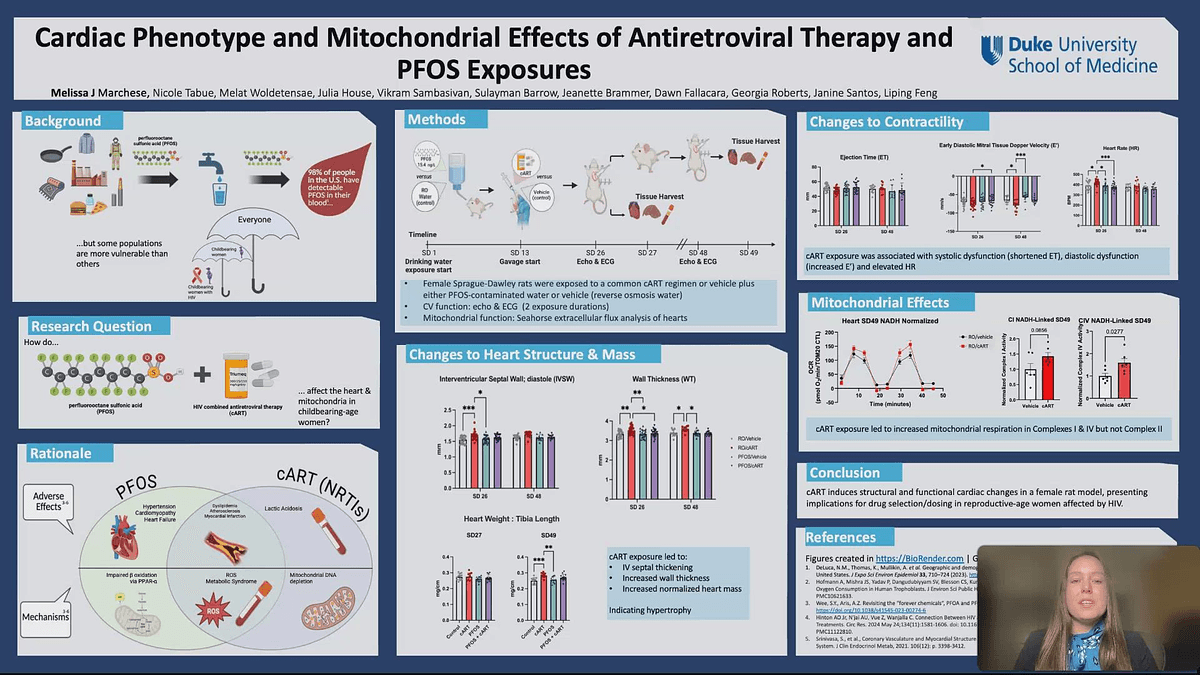
The majority of people living with HIV globally are women and girls. Although combined antiretroviral therapy (cART) can drastically improve prognosis and prevent vertical transmission, its off-target metabolic and systemic effects in pregnant women and women of childbearing age remain understudied. Concurrent exposure to ubiquitous environmental pollutants, such as per and polyfluoroalkyl substances (PFAS), may interact with cART to impact maternal health, given their shared potential for mitochondrial and cardiotoxicity. Our broader project investigates the combined structural, functional, and molecular impact of cART and a legacy PFAS compound, perfluorooctanesulfonic acid (PFOS), on cardiometabolic outcomes in a rat model. Here, we present findings from non-pregnant animals, which will later be compared to pregnant counterparts.
Methods
Female Sprague-Dawley rats were treated with cART (abacavir/dolutegravir/lamivudine; Triumeq at 300/25/150 mg/kg/day) or vehicle (aqueous methylcellulose/Tween 80). Animals also received either PFOS-contaminated water, directly mimicking concentrations measured in a North Carolina community, or vehicle (reverse osmosis-filtered water). They received echocardiography and electrocardiography immediately prior to tissue harvest at study day (SD) 27 or SD 49. Tissue and plasma samples underwent PFAS quantification, pathological evaluation, qPCR, and mitochondrial function analysis.
Results
The non-pregnant cohort demonstrated perturbations in several structural and functional parameters by exposure group. Echocardiography revealed shortened ejection times at SD 26 in the cART group compared to controls, indicating early systolic dysfunction. Rats in the PFOS + cART group showed slower isovolumetric relaxation times and increased ejection fractions at SD 26. Structural changes included increased interventricular septal thickness, posterior wall thickness, and left ventricular (LV) mass in the cART group. At SD 48, persistent hypertrophy was demonstrated by increased LV mass and heart weight:tibia length ratios for the cART-exposed rats. Surprisingly, cART alone did not impact mitochondrial copy number. However, both the PFOS and PFOS + cART groups showed reduced mitochondrial copy numbers and increased deletions, indicating alterations to the mitochondrial genome.
Conclusion
These findings suggest that cART exposure, particularly in combination with PFOS, alters cardiac structure and function, with early systolic impairment followed by compensatory adaptations. Despite partial recovery over time, persistent hypertrophy suggests cardiac remodeling. Ongoing analysis of pregnant animals will determine whether the added physiologic strain of pregnancy sensitizes the cardiovascular system of the animals. This work highlights a need to evaluate the cardiovascular safety of cART in the context of common environmental exposures, particularly in women of reproductive age.