2025 AMA Research Challenge – Member Premier Access

October 22, 2025

Virtual only, United States

Would you like to see your presentation here, made available to a global audience of researchers?
Add your own presentation or have us affordably record your next conference.

Background

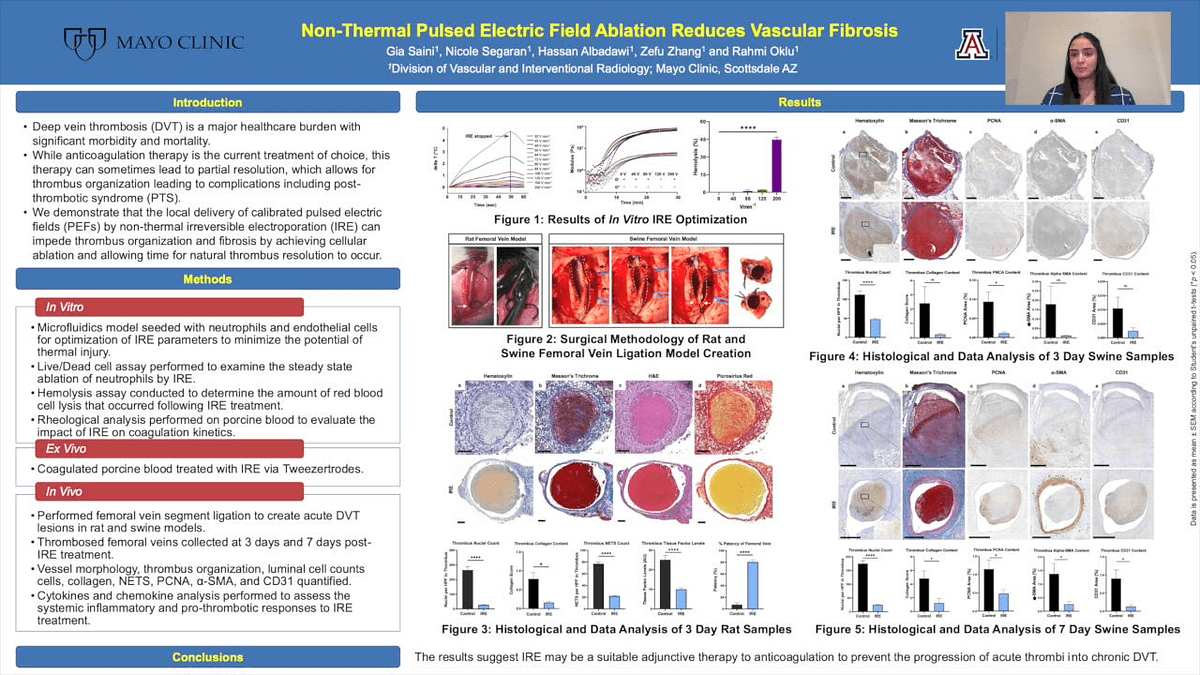
Deep vein thrombosis (DVT) is a major healthcare burden with significant morbidity and mortality. Anticoagulation therapy is the current treatment of choice. However, this approach can sometimes lead to only partial resolution, allowing for thrombus organization. This can result in the development of post-thrombotic syndrome (PTS), a sequela of chronic DVT that includes symptoms such as limb pain, cramping, edema, stasis dermatitis, or even venous ulceration. There is currently no effective treatment for PTS, and as a consequence, it can become a lifelong problem that significantly impairs a patient’s quality of life. Here, we examine whether the local delivery of non-thermal irreversible electroporation (IRE) can impede thrombus organization and fibrosis by achieving cellular ablation and allowing time for natural thrombus resolution to occur.

Methods

In vitro and ex vivo methods were utilized to investigate the thermal and ablative effects of IRE. A microfluidics device was seeded with neutrophils and endothelial cells to determine voltage thresholds for selective, safe ablation. Rheological analysis was conducted to evaluate the impact of IRE on blood coagulation. Porcine blood clots, generated in a syringe model, were used to assess red blood cell and fibrin architecture following IRE treatment. These models guided the optimization of IRE parameters for subsequent in vivo studies. Calibrated pulsed electric fields were then delivered locally using a tweezer-style electrode system to target acute DVT lesions induced in the femoral veins of rat and swine models. Animals were monitored for three or seven days post-treatment. Histological, immunohistochemical, and molecular analyses were performed to assess thrombus organization, vessel integrity, luminal cellularity, cytokine expression, and inflammatory or fibrotic markers following IRE-treatment.

Results

IRE-treated blood demonstrated preserved clotting kinetics and minimal hemolysis, supporting the safety and efficacy of blood cell ablation using IRE. Histologic analysis of IRE-treated animal femoral vein segments revealed significantly reduced cellular proliferation, collagen deposition, and angiogenesis. IRE-treated tissues also exhibited lower expression of pro-fibrotic, pro-thrombogenic, and pro-coagulant markers compared to controls. Across both models, vessel wall thickness and luminal architecture remained intact, confirming the non-destructive nature of IRE, with no evidence of structural wall damage or aneurysm formation.

Conclusion

These findings suggest that IRE may serve as a promising adjunctive therapy to anticoagulation by preventing the organization of acute thrombi into chronic DVT. This could ultimately reduce the incidence of post-thrombotic syndrome and improve long-term patient outcomes.

Downloads

Transcript English (automatic)

Next from 2025 AMA Research Challenge – Member Premier Access

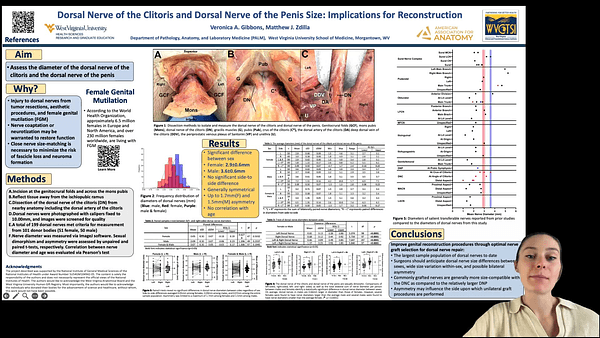
Dorsal Nerve of the Clitoris and Dorsal Nerve of the Penis Size: Implications for Reconstruction

Dorsal Nerve of the Clitoris and Dorsal Nerve of the Penis Size: Implications for Reconstruction

2025 AMA Research Challenge – Member Premier Access

Veronica Gibbons

22 October 2025