Would you like to see your presentation here, made available to a global audience of researchers?
Add your own presentation or have us affordably record your next conference.
Background
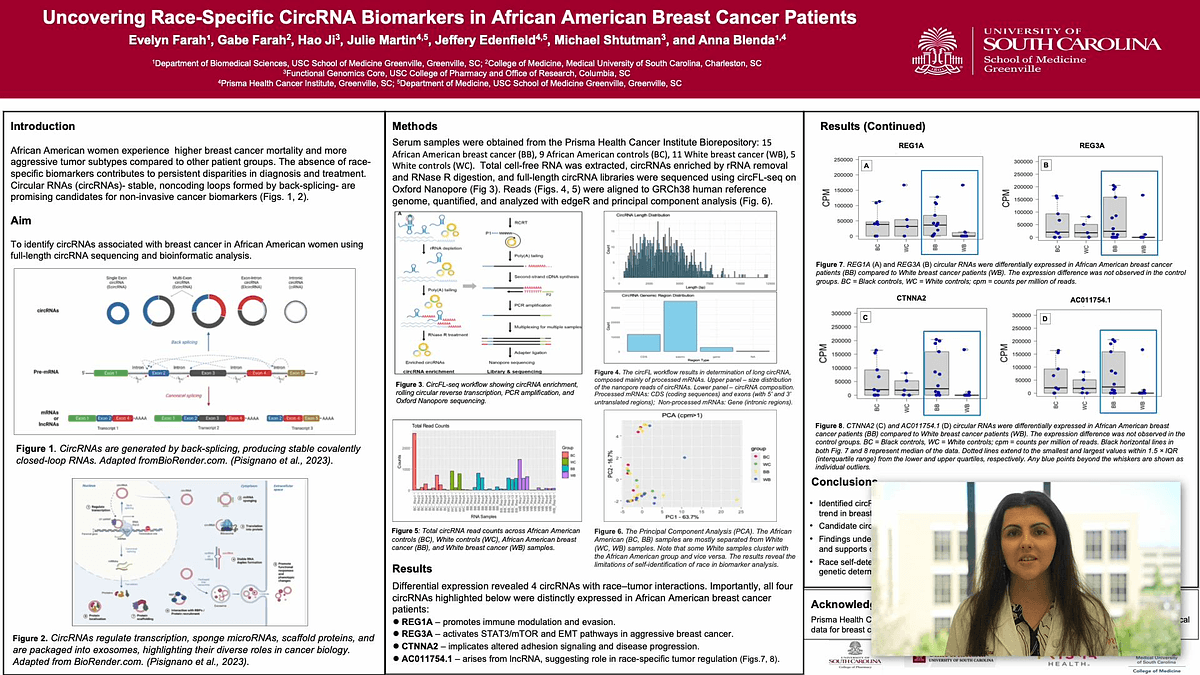
African American women experience higher breast cancer mortality and are more frequently diagnosed with aggressive tumor subtypes compared to other racial and ethnic groups. Despite advances in cancer genomics, the absence of population-specific diagnostic tools contributes to persistent disparities in clinical outcomes. Circular RNAs (circRNAs) are stable, non-coding RNAs with emerging potential as non-invasive biomarkers in cancer detection and profiling. This study aims to identify tumor-associated circRNAs in African American breast cancer patients using a circRNA analysis pipeline. Discovering circRNA biomarkers specific to African American patients is a key step toward advancing precision oncology and achieving equity in cancer diagnostics and treatment.
Methods
Serum samples from 35 breast cancer patients and 15 healthy female controls were obtained from the Prisma Health Cancer Institute Biorepository. Following cell-free RNA isolation and circRNA enrichment, full-length circRNA libraries were prepared using the circFL-seq protocol and sequenced using Oxford Nanopore long-read technology. After basecalling and adapter trimming, reads were aligned to the GRCh38 human reference genome. Differential expression analysis using edgeR identified circRNAs associated with cancer status. Expression profiles were compared to public circRNA datasets from individuals of European ancestry to assess race-associated differences.
Results
Differential gene expression analysis identified 11 circRNAs associated with race, 27 with tumor status, and 4 showing a race-tumor interaction, revealing race-specific differences in breast tumor biology. Among these, circRNAs from REG3A, a secreted lectin involved in inflammatory signaling and epithelial-mesenchymal transition (EMT), were upregulated in African-American tumors. REG3A drives tumor progression through STAT3 and mTOR activation. Similarly, circRNAs from REG1A, a secreted lectin involved in immune modulation, were upregulated and are linked to tumor progression and resistance to immune surveillance. CircRNAs from CTNNA2, a cell adhesion gene, were upregulated, indicating altered adhesion signaling and a potential regulatory role in tumor progression. In addition, AC011754.1, a long noncoding RNA was also differentially expressed and may contribute to race-specific tumor regulation.
Conclusion
This study identifies a race-specific gene expression profile in African-American breast cancer involving dysregulation of immune and epithelial pathways. CircRNAs from REG1A, REG3A, CTNNA2, and AC011754.1 may act as molecular drivers of aggressive tumor phenotypes and serve as race-conscious diagnostic and therapeutic biomarkers. CircRNAs regulate gene expression by blocking microRNAs, limiting their ability to suppress targets involved in proliferation, invasion, and immune response. These findings highlight a critical gap in cancer genomics and underscores the need to integrate race-informed molecular data into precision oncology to drive equitable biomarker discovery and improve outcomes in underrepresented populations.