2025 AMA Research Challenge – Member Premier Access

October 22, 2025

Virtual only, United States

Would you like to see your presentation here, made available to a global audience of researchers?
Add your own presentation or have us affordably record your next conference.

Background

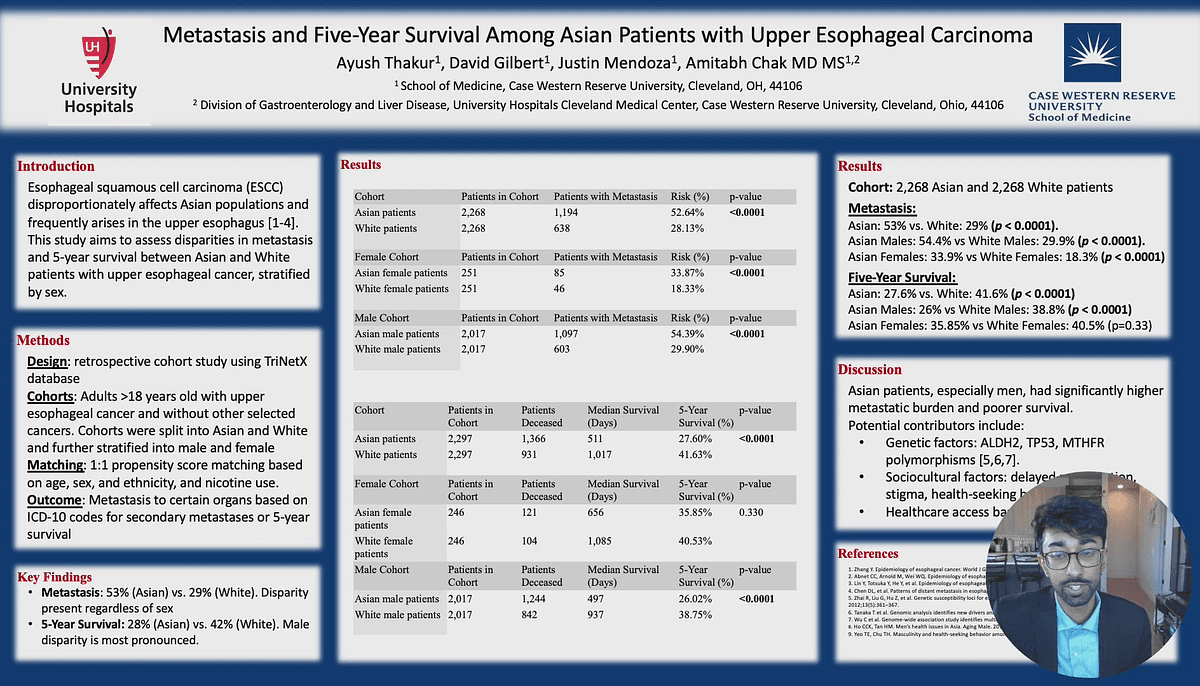
Esophageal squamous cell carcinoma (ESCC) disproportionately affects Asian populations and frequently arises in the upper esophagus. Although racial differences in ESCC incidence are recognized, real-world evidence comparing metastatic burden and survival outcomes between Asian and White patients remains scarce. Even less is known about whether these disparities differ by sex. This study evaluates racial disparities in metastasis and 5-year survival among patients with upper esophageal cancer, with novel stratification by sex.

Methods

We performed a retrospective cohort study using the TriNetX Research Network. Adults (≥18 years) with upper esophageal cancer were identified by ICD-10-CM and ICD-O codes with exclusion of many other cancers. Asian and White patients were propensity score matched 1:1 on age, sex, ethnicity, and nicotine use, then stratified by sex. Metastasis was defined as secondary malignancies to high-yield organs documented after the index upper esophageal cancer diagnosis. Survival was analyzed with Kaplan–Meier methods. Hazard ratios (HR), risk ratios (RR), odds ratios (OR), and 95% confidence intervals (CI) were calculated.

Results

The matched cohort included 2,268 Asian and 2,268 White patients. Metastasis occurred more frequently in Asian patients (53.0% vs. 29.0%; RR 1.84, OR 2.80, p < 0.0001). Five-year survival was significantly lower in Asian patients (27.6% vs. 41.6%; HR 1.42, p < 0.0001). Among males, metastasis was 54.4% in Asian males vs. 29.9% in White males (p < 0.0001), with 5-year survival of 26.0% in Asian males vs. 38.8% in White males (p < 0.0001). Among females, metastasis remained higher in Asian females (33.9% vs. 18.3%; p < 0.0001), but survival differences were not statistically significant (35.9% vs. 40.5%; p = 0.33).

Conclusions

Asian patients with upper esophageal cancer, regardless of sex, experience greater metastatic burden compared to their White counterparts. Regarding differences in 5-year survival, Asian patients overall have a decreased survival compared to White patients, mainly attributable to the discrepancies between the male cohorts, with minimal significance in the female cohorts. These disparities may reflect a combination of biological predisposition, decreased health-seeking behaviors, and systemic barriers to care. To address these inequities, culturally tailored screening, early detection, and intervention strategies are urgently needed in high-risk populations, especially in Asian men.

Downloads

Transcript English (automatic)

Next from 2025 AMA Research Challenge – Member Premier Access

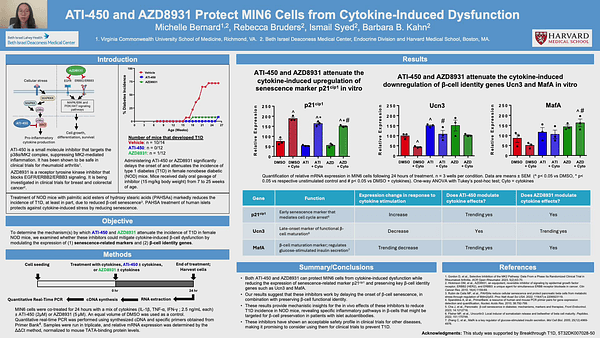
ATI-450 and AZD8931 Protect MIN6 Cells from Cytokine-Induced Dysfunction

ATI-450 and AZD8931 Protect MIN6 Cells from Cytokine-Induced Dysfunction

2025 AMA Research Challenge – Member Premier Access

Michelle Bernard

22 October 2025