Would you like to see your presentation here, made available to a global audience of researchers?
Add your own presentation or have us affordably record your next conference.
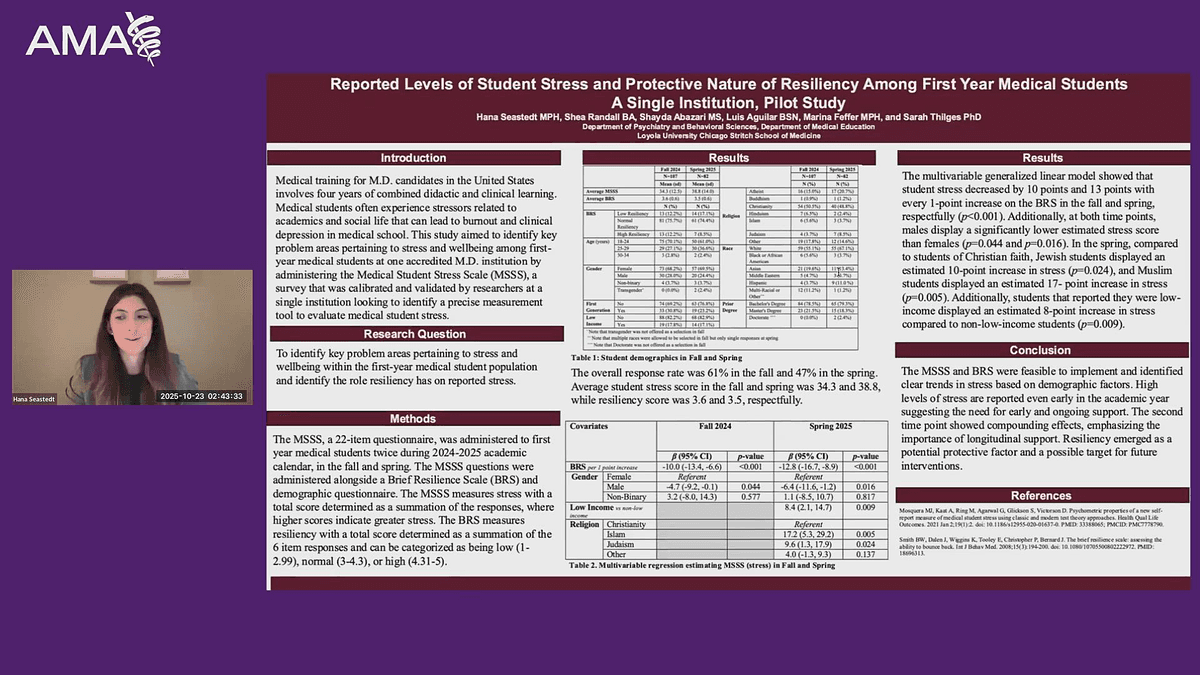
Abstract Title: Reported Levels of Student Stress and Protective Nature of Resiliency Among First Year U.S. Medical Students - A Single Institution, Pilot Study
Background: Medical training for M.D. candidates in the United States involves four years of combined didactic and clinical learning. Medical students often experience stressors related to academics and social life that can lead to burnout and clinical depression in medical school. This study aimed to identify key problem areas pertaining to stress and wellbeing among first-year medical students at one accredited M.D. institution by administering the Medical Student Stress Scale (MSSS), a survey that was calibrated and validated by researchers at a single institution looking to identify a precise measurement tool to evaluate medical student stress.
Methods The MSSS, a 22-item questionnaire, was administered to first year medical students twice during 2024-2025 academic calendar, in the fall and spring. The MSSS questions were administered alongside a Brief Resilience Scale (BRS) and demographic questionnaire. The MSSS measures stress with a total score determined as a summation of the responses, where higher scores indicate greater stress. The BRS measures resiliency with a total score determined as a summation of the 6 item responses and can be categorized as being low (1-2.99), normal (3-4.3), or high (4.31-5).
Results The overall response rate was 61% (107 out of 175) in the fall and 47% (87 out of 175) in the spring. Average student stress score in the fall and spring was 34.3 and 38.8, respectfully. The resiliency score in the fall and spring was 3.6 and 3.5, respectfully. The multivariable generalized linear model showed that student stress decreased by 10 points and 13 points with every 1-point increase on the BRS in the fall and spring, respectfully (p<0.001). Additionally, at both time points, males display a significantly lower estimated stress score than females (p=0.044 and p=0.016). In the spring, compared to students of Christian faith, Jewish students displayed an estimated 10-point increase in stress (p=0.024), and Islamic students displayed an estimated 17- point increase in stress (p=0.005). Additionally, students that reported they were low-income displayed an estimated 8-point increase in stress compared to non-low-income students (p=0.009).
Conclusion The MSSS and BRS were feasible to implement and identified clear trends in stress based on demographic factors. High levels of stress are reported even early in the academic year suggesting the need for early and ongoing support. The second time point showed compounding effects, emphasizing the importance of longitudinal support. Resiliency emerged as a potential protective factor and a possible target for future interventions.