Would you like to see your presentation here, made available to a global audience of researchers?
Add your own presentation or have us affordably record your next conference.
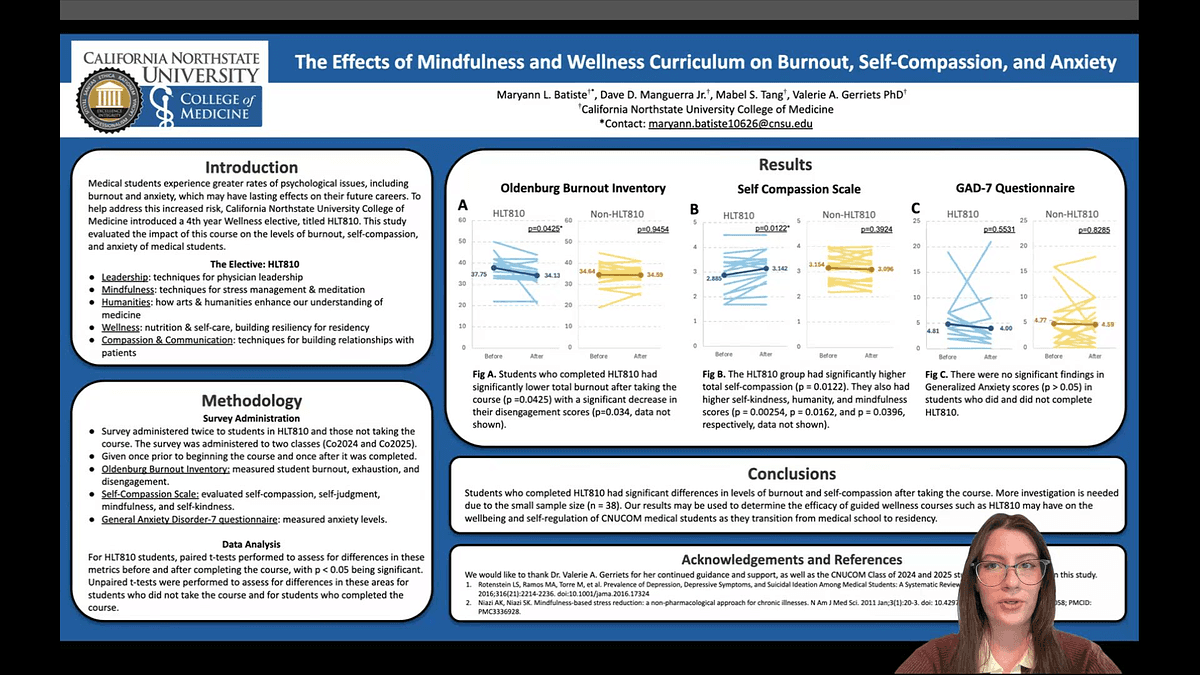
Background: Medical students experience greater rates of psychological issues, including burnout and anxiety, which may have lasting effects on their future careers. To help address this increased risk, California Northstate University College of Medicine introduced a 4th year Wellness elective, which combines elements of mindfulness meditation, physician compassion and communication training, leadership training, and humanities in medicine. This study evaluated the impact of this course on the levels of burnout, self-compassion, and anxiety of medical students.
Methods: A survey was administered to 4th year students, both those enrolled in HLT810 and those not taking the course. The survey consisted of demographic questions as well as measurements for burnout, self-compassion, and anxiety. The survey was given prior to beginning the course and again after it was completed. The Oldenburg Burnout Inventory was used to measure student burnout, exhaustion, and disengagement. The Self-Compassion Scale was used to evaluate self-compassion, self-judgment, mindfulness, and self-kindness. The General Anxiety Disorder-7 questionnaire was used to measure anxiety levels. For students who took the elective, two-tailed paired t-tests were performed to assess for differences in these metrics before and after completing the course, with p < 0.05 being significant. Unpaired t-tests were used to compare students who did not take the course to students who completed the course.
Results: There were no significant differences in anxiety levels, self-compassion, and burnout between students who completed the HLT810 elective and those who did not. However, for the students who completed the elective, there were significantly lower total burnout and disengagement scores after taking the course (p = 0.043 and p = 0.034, respectively), as well as significantly higher self-kindness, humanity, and mindfulness scores (p = 0.00254, p = 0.0162, and p = 0.0396, respectively). These students also had significantly higher total self-compassion scores after completing the course (p = 0.0122). For students who did not take the course, engagement scores were significantly higher after the course concluded (p = 0.024) but there were no other findings of significance.
Conclusion: Students who completed HLT810 had statistically significant decreased levels of burnout and as well as increased self-compassion after taking the course. While additional investigation is needed due to the small sample size (n = 38), these findings suggest that a 4th year wellness elective course may offer meaningful benefits for medical student well-being.