2025 AMA Research Challenge – Member Premier Access

October 22, 2025

Virtual only, United States

Would you like to see your presentation here, made available to a global audience of researchers?
Add your own presentation or have us affordably record your next conference.

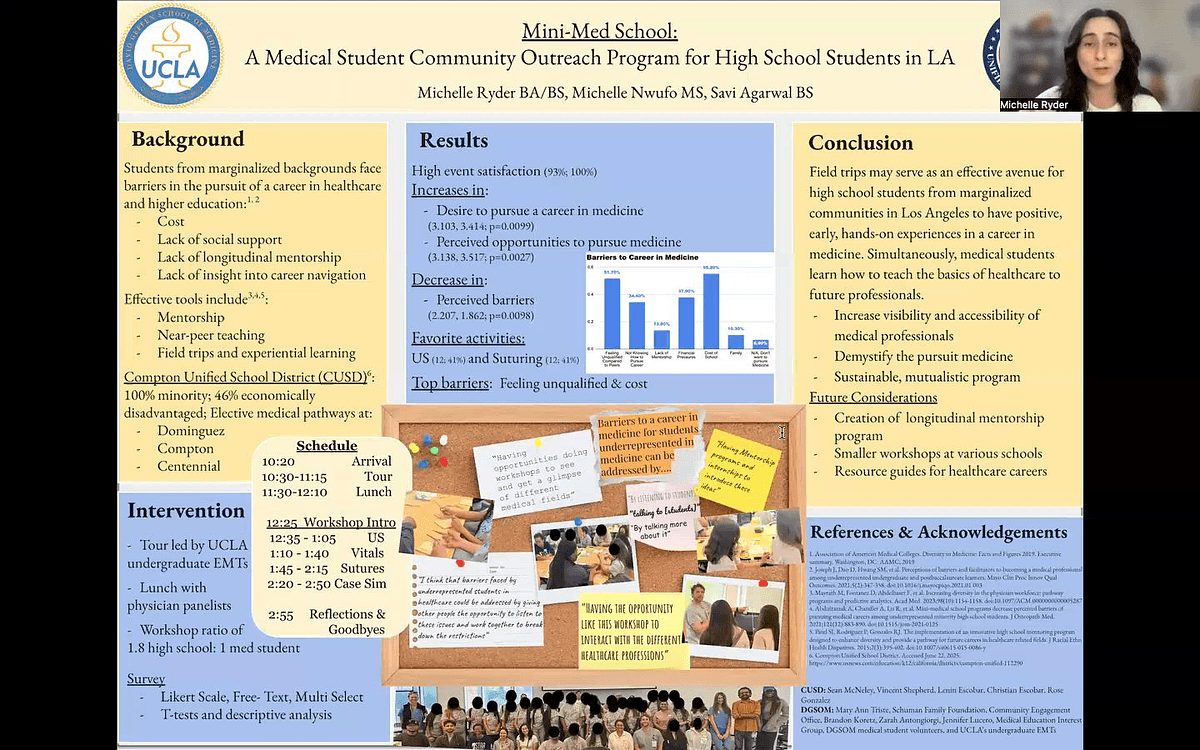
Background Students from marginalized backgrounds are underrepresented in higher education, including healthcare.1 Representation in medicine can decrease health disparities through increased trust, patient-centered care, and better treatment adherence.2,3,4 Systemic barriers like cost, lack of social support, lack of mentorship, and lack of career navigation knowledge, prevent marginalized persons from pursuing medicine.5 Encouraging marginalized high schoolers to pursue medicine is shown to help to minimize the disparity and further diversify representation in medicine.6,7 Compton Unified School District (CUSD) teachers revealed a scarcity of medical opportunities for their students. CUSD serves 100% minority students and 46% are economically disadvantaged.8 Literature has shown mentorship programs, medical school field trips, and near-peer teaching decrease barriers.7,9,10 Utilizing these strategies, we created a single event field trip for Los Angeles students to explore medicine. A survey was issued to high school and medical students to measure the effects on barriers and to obtain feedback.

Methods High school students from CUSD were invited to David Geffen School of Medicine. Pre-medical undergraduates led the students through a tour of UCLA. Physicians hosted conversations during lunch. Medical students led hands-on, small group (1.8 student: 1 medical student) workshops including ultrasound, suturing, vital signs, and simulated patient interviews. After participating in the program, both high school and medical students completed an anonymous survey with Likert Scale (0-4), free-text, and multi-select questions. Data were evaluated with paired two-tailed t-tests and descriptive analysis.

Results Twenty-nine high school students and twelve medical students completed the survey. Amongst the high school students, there were statistically significant increases in desire to pursue a career in medicine (3.103, 3.414; p=0.0099) and perceived opportunities to pursue medicine (3.138, 3.517; p=0.0027). Perceived barriers had a significant decrease (2.207, 1.862; p=0.0098). The most common barriers identified were feeling unqualified compared to peers (51.7%; 15) and cost of education (55.2%;16). There was no change in self efficacy (3.103, 3.276; p=0.057). The event had high satisfaction by both high school (93%, 3.51土0.62) and medical students (100%) with requests to host event again.

Conclusion Field trips are effective tools for Los Angeles-area high school students from marginalized backgrounds to explore medicine and decrease barriers. The mutual satisfaction from medical student-run events for high school students make this program sustainable. Future projects aim to create a more longitudinal partnership with CUSD.

  1. Association of American Medical Colleges. Diversity in Medicine: Facts and Figures 2019. Executive summary. Washington, DC: AAMC; 2019.
  2. Hall WJ, Chapman MV, Lee KM, et al. Implicit racial/ethnic bias among health care professionals and its influence on health care outcomes: a systematic review. Am J Public Health. 2015;105(12):e60-e76. doi:10.2105/AJPH.2015.302903
  3. Smedley BD, Stith AY, Nelson AR, eds. Patient-provider communication: the effect of race and ethnicity on process and outcomes of healthcare. Unequal Treatment: Confronting Racial and Ethnic Disparities in Health Care. Washington, DC: National Academies Press; 2003. https://www.ncbi.nlm.nih.gov/books/NBK220354/
  4. GlobalData Plc. The Complexities of Physician Supply and Demand: Projections From 2021 to 2036. Washington, DC: Association of American Medical Colleges; 2024.
  5. Joseph J, Dao D, Hwang SM, et al. Perceptions of barriers and facilitators to becoming a medical professional among underrepresented undergraduate and postbaccalaureate learners. Mayo Clin Proc Innov Qual Outcomes. 2021;5(2):347-358. doi:10.1016/j.mayocpiqo.2021.01.003
  6. Goodfellow A, Ulloa JG, Dowling PT, et al. Predictors of primary care physician practice location in underserved urban or rural areas in the United States: a systematic literature review. Acad Med. 2016;91(9):1313-1321. doi:10.1097/ACM.0000000000001203
  7. Mayrath M, Fontanez D, Abdelbaset F, et al. Increasing diversity in the physician workforce: pathway programs and predictive analytics. Acad Med. 2023;98(10):1154-1158. doi:10.1097/ACM.0000000000005287
  8. Compton Unified School District. Accessed June 22, 2025. https://www.usnews.com/education/k12/california/districts/compton-unified-112290
  9. Abdulrazzak A, Chandler A, Lu R, et al. Mini-medical school programs decrease perceived barriers of pursuing medical careers among underrepresented minority high school students. J Osteopath Med. 2021;121(12):883-890. doi:10.1515/jom-2021-0125
  10. Patel SI, Rodríguez P, Gonzales RJ. The implementation of an innovative high school mentoring program designed to enhance diversity and provide a pathway for future careers in healthcare related fields. J Racial Ethn Health Disparities. 2015;2(3):395-402. doi:10.1007/s40615-015-0086-y

Downloads

Transcript English (automatic)

Next from 2025 AMA Research Challenge – Member Premier Access

The Impact of Racial Bias Discussions on Medical Students' Educational Experiences and Perceptions of Patient Care

The Impact of Racial Bias Discussions on Medical Students' Educational Experiences and Perceptions of Patient Care

2025 AMA Research Challenge – Member Premier Access

Sirlin Kaur

22 October 2025