Would you like to see your presentation here, made available to a global audience of researchers?
Add your own presentation or have us affordably record your next conference.
Abstract Title
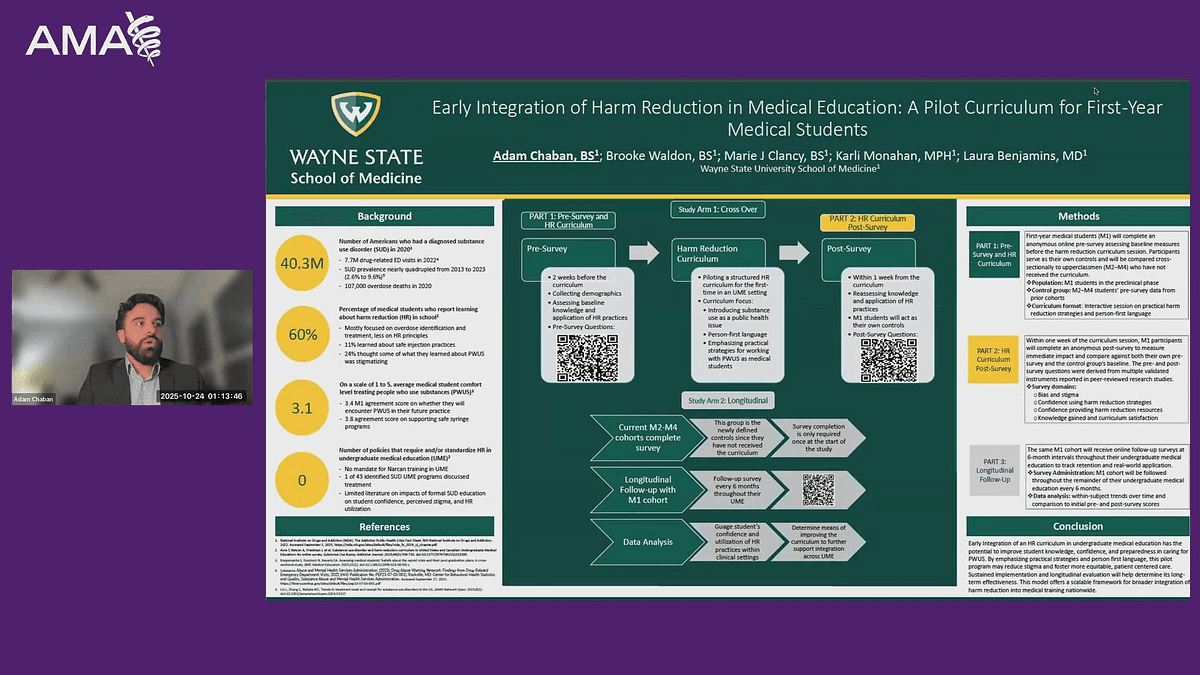
Early Integration of Harm Reduction in Medical Education: A Pilot Curriculum for First-Year Medical Students
Background
Harm reduction is an evidence-based public health framework that mitigates the adverse outcomes associated with substance use, mental health crises, and other high-risk behaviors without requiring abstinence. Harm reduction training implemented in graduate medical education has enhanced physician preparedness and effectiveness in caring for people struggling with substance abuse and the formation of trusting patient-physician relationships. These principles are rarely emphasized in formal undergraduate medical training. Consequently, medical students often begin clinical practice without adequate preparation to provide effective, compassionate care for people who use illicit substances, and frequently lack the tools to reduce stigma, establish trust, and apply evidence-based interventions. Despite the proven effectiveness of harm reduction principles in reducing overdose deaths, transmission of infectious diseases, and facilitating the development of a trusting patient-physician relationship to improve patient treatment outcomes, a structured curriculum for harm reduction strategies is lacking in formal undergraduate medical education. This study aims to evaluate the impact of a newly developed pilot curriculum for first-year medical students, assessing their comprehension and application of harm reduction principles throughout their undergraduate medical education.
Methods
A novel harm reduction curriculum introduced in the preclinical phase of medical education, with a focus on practical strategies and person-first language to enhance the patient-centered care of those who use illicit substances. An anonymous, online pre- and post- questionnaire will assess first year medical student’s perspectives, bias, beliefs, preparedness, knowledge, and confidence utilizing harm reduction strategies. The curriculum and questionnaires will be administered to first year undergraduate medical students before and after the education session and longitudinally throughout their undergraduate medical education. Participants will serve as their own cross-sectional controls through the pre- and post-curriculum surveys, and longitudinal comparisons will be made using a control group of students from preceding academic years who have not received the novel harm reduction curriculum.
Results
Pending IRB approval, the curriculum is set to take place in November 2025.
Conclusion
We anticipate the harm reduction curriculum will lead to sustained improvements in the medical student's knowledge, confidence, and clinical application of harm reduction principles. By embedding these practices early in medical training, the curriculum has the potential to shift institutional culture and reduce stigma toward people who use illicit substances, and better prepare future physicians to deliver equitable, person-centered care. This model may serve as a scalable framework for nationwide integration into undergraduate medical health education.