2025 AMA Research Challenge – Member Premier Access

October 22, 2025

Virtual only, United States

Would you like to see your presentation here, made available to a global audience of researchers?
Add your own presentation or have us affordably record your next conference.

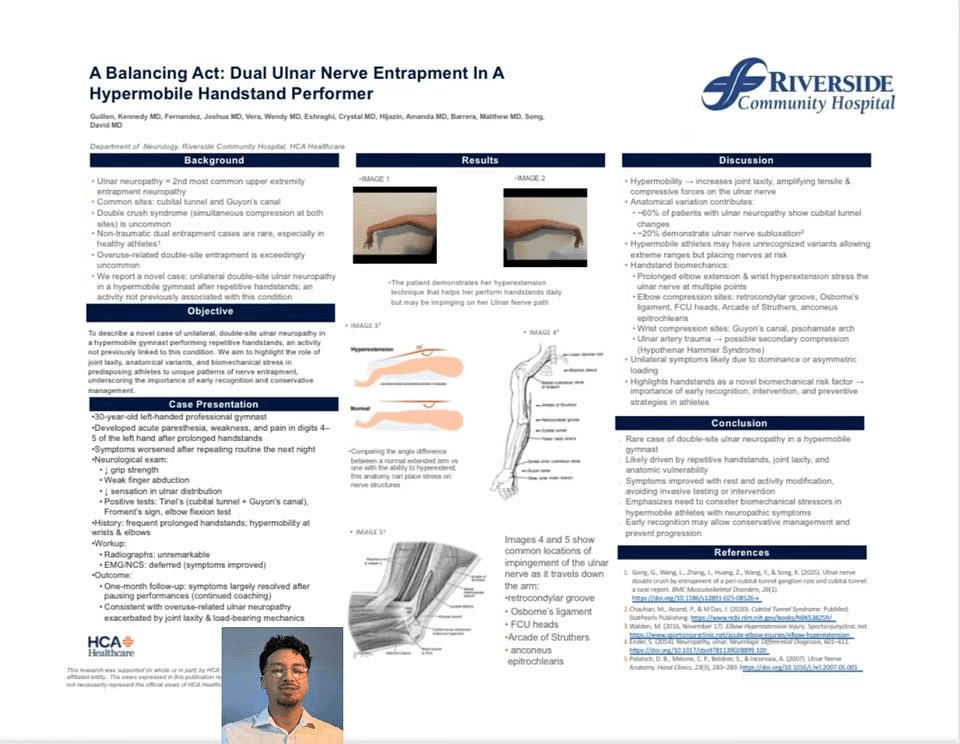
Background: Ulnar neuropathy is the second most common upper extremity entrapment neuropathy, typically occurring at the cubital tunnel or Guyon’s canal. Simultaneous compression at both sites, referred to as “double crush syndrome” is not common; examples of double entrapment involving compression and cubital tunnel entrapment unrelated to trauma are rare. Reports of dual-site entrapment in otherwise healthy athletes, particularly from overuse, are exceedingly uncommon. We present a novel case of unilateral, double-site ulnar neuropathy in a hypermobile gymnast following repetitive handstands; an activity not previously associated with this condition. Case Presentation: A 30-year-old left-handed professional gymnast presented with acute paresthesia, weakness, and pain in the fourth and fifth digits of her left hand following a performance involving prolonged handstands. She repeated the routine the next night, after which symptoms intensified. Neurological examination showed decreased grip strength, weakness in finger abduction, and reduced sensation in the ulnar distribution. Tinel’s sign was positive at both the cubital tunnel and Guyon’s canal. Froment’s sign and the elbow flexion test were also positive. The patient reported frequent long-duration handstands several times per week and demonstrated hypermobility at the wrists and elbows. Radiographs were unremarkable; electromyography and nerve conduction studies was deferred due to improvement. At one-month follow-up, after pausing performances but continuing to coach, her symptoms largely resolved, consistent with overuse-related ulnar neuropathy exacerbated by joint laxity and load-bearing mechanics. Discussion: Hypermobility increases joint laxity and amplifies tensile and compressive forces on the ulnar nerve. Anatomical variations may further predispose to entrapment; close to 60% of patients had anatomical changes in the cubital tunnel that caused the ulnar nerve neuropathy, of which nearly 20% of patients had a subluxation of the ulnar nerve. Hypermobile athletes may have unrecognized variants that tolerate extreme ranges but place neural structures at risk. During handstands, prolonged elbow extension and wrist hyperextension stress the ulnar nerve at multiple points. At the elbow, compression may occur at the retrocondylar groove, beneath Osborne’s ligament, between the flexor carpi unaris heads, or due to variants like the Arcade of Struthers or anconeus epitrochlearis. At the wrist, Guyon’s canal and pisohamate arch can entrap the motor branch, while trauma to the nearby ulnar artery may produce secondary compression (Hypothenar Hammer Syndrome). Unilateral symptoms may reflect dominance or asymmetric loading. Recognizing handstands as a potential biomechanical risk factor may guide early intervention and inform preventive strategies in similar athletic populations.

Downloads

Transcript English (automatic)

Next from 2025 AMA Research Challenge – Member Premier Access

A unique case of spinal-predominant ICANS with long-term motor deficits after CAR-T therapy

A unique case of spinal-predominant ICANS with long-term motor deficits after CAR-T therapy

2025 AMA Research Challenge – Member Premier Access

Samantha Armas

22 October 2025