Would you like to see your presentation here, made available to a global audience of researchers?
Add your own presentation or have us affordably record your next conference.
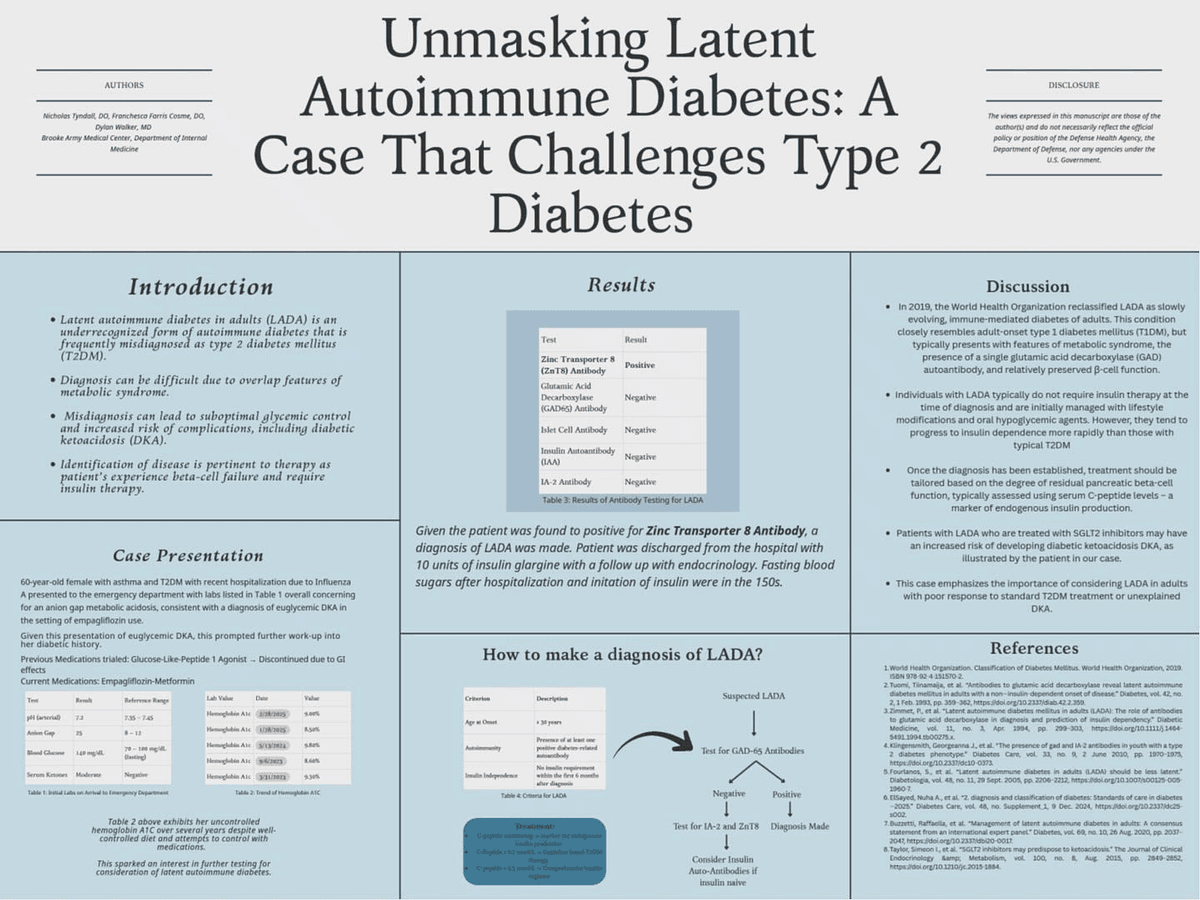
Background Latent autoimmune diabetes in adults (LADA) is an underrecognized slowly progressive form of autoimmune diabetes that presents in adulthood and is frequently misdiagnosed as type 2 diabetes mellitus (T2DM) due to its indolent progression and overlap features of metabolic syndrome. Patients may initially respond to oral hypoglycemic agents but eventually require insulin therapy due to progressive beta-cell failure. Misdiagnosis can lead to suboptimal glycemic control and increased risk of complications, including DKA. Case Presentation A 60-year-old woman with asthma, hyperlipidemia, and type 2 diabetes was initially admitted to the ICU for euglycemic DKA. This occurred three weeks after a hospitalization for influenza. A–related respiratory failure. Labs in the ED revealed a high anion gap metabolic acidosis (gap 25, pH 7.2), blood glucose of 140 mg/dL, and moderate ketones, confirming euglycemic DKA. She was compliant with her medications, including empagliflozin/metformin, but was not on insulin. Her HbA1c was 8.5%. From 2023–2025, she had eight diabetes-focused visits with consistent medication adherence. A prior GLP-1 trial was discontinued due to GI side effects. Despite nutrition counseling and lifestyle changes, her HbA1c remained between 8.5–9.3%. LADA was suspected and confirmed with positive ZnT8 antibodies. She was started on Lantus 10 units nightly and referred to endocrinology. At follow-up, fasting glucose averaged 150 mg/dL—an improvement from baseline. Discussion In 2019, the WHO reclassified LADA as slowly evolving, immune-mediated diabetes in adults. It resembles adult-onset type 1 diabetes but presents with metabolic syndrome features, a single autoantibody (often GAD), and preserved β-cell function. LADA typically affects adults misdiagnosed with T2DM who test positive for pancreatic autoantibodies (GAD, IA-2, or ZnT8). These patients initially manage without insulin but progress to insulin dependence faster than typical T2DM. The Immunology of Diabetes Society defines LADA by age ≥30, at least one positive diabetes-related autoantibody, and no insulin requirement within six months of diagnosis. C-peptide helps guide therapy: levels ≥0.7 nmol/L may allow for T2DM management, while < 0.3 nmol/L warrants full insulin therapy. SGLT-2 inhibitors, though cardioprotective in T2DM, pose a risk in LADA due to their association with euglycemic DKA. This is believed to result from increased glucagon, hepatic ketogenesis, and impaired ketone clearance. As β-cell function declines, the risk of DKA rises, similar to T1DM. Misdiagnosis of LADA as T2DM often delays appropriate treatment, increasing the likelihood of poor glycemic control and complications like DKA.