2025 AMA Research Challenge – Member Premier Access

October 22, 2025

Virtual only, United States

Would you like to see your presentation here, made available to a global audience of researchers?
Add your own presentation or have us affordably record your next conference.

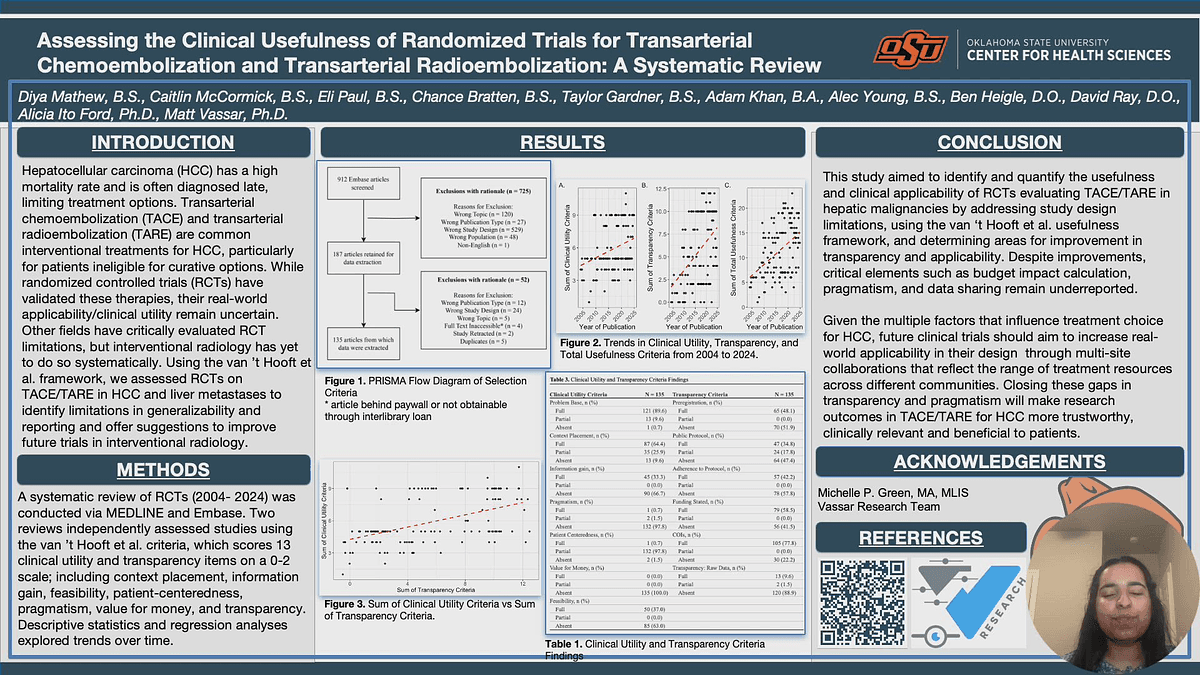
Background Hepatocellular carcinoma (HCC) has a high mortality rate and is often diagnosed late, limiting treatment options. ​​Transarterial chemoembolization (TACE) and transarterial radioembolization (TARE) are common interventional treatments for HCC, particularly for patients ineligible for curative options. While randomized controlled trials (RCTs) have validated these therapies, their real-world applicability and clinical utility remain uncertain. Other fields have critically evaluated RCT limitations, but interventional radiology has yet to do so systematically. Using the van ’t Hooft et al. framework, we assessed RCTs on TACE/TARE in HCC and liver metastases to identify limitations in generalizability and reporting and offer suggestions to improve future trials in interventional radiology.

Methods A systematic review of RCTs published from 2004 to 2024 was conducted via MEDLINE and Embase. Screening and assessment was conducted by two reviewers based on the van ’t Hooft et al. criteria, which scores 13 clinical utility and transparency items on a 0-2 scale; including context placement, information gain, feasibility, patient-centeredness, pragmatism, value for money, and transparency. Descriptive statistics and regression analyses explored trends over time.

Results Among 135 included RCTs out of the 912 records, most performed well in areas like context placement and conflict-of-interest disclosure. However, major gaps were found in raw data availability (9.6%), self-evaluated cost-value analysis (0%), and self-evaluation for pragmatism (0.7%). Total usefulness improved over time, with transparency rising more than clinical utility between 2004 and 2024. A significant positive correlation was found between transparency and clinical utility (r = 0.50, p < .001), highlighting the need for more pragmatic and transparent trials to guide interventional radiology practice.

Conclusion This study aimed to identify and quantify the usefulness and clinical applicability of RCTs evaluating TACE/TARE in hepatic malignancies by addressing study design limitations, using the van ‘t Hooft et al. usefulness framework, and determining areas for improvement in transparency and applicability. Despite improvements, critical elements such as budget impact calculation, pragmatism, and data sharing remain underreported. Given the multiple factors that influence treatment choice for HCC, future clinical trials should aim to increase real-world applicability in their design through multi-site collaborations that reflect the range of treatment resources across different communities. Closing these gaps in transparency and pragmatism will make research outcomes in TACE/TARE for HCC more trustworthy, clinically relevant and beneficial to patients.

Downloads

Transcript English (automatic)

Next from 2025 AMA Research Challenge – Member Premier Access

When the Usual Suspects Aren’t to Blame: A Case of Stenotrophomonas Osteomyelitis in a Diabetic Foot

When the Usual Suspects Aren’t to Blame: A Case of Stenotrophomonas Osteomyelitis in a Diabetic Foot

2025 AMA Research Challenge – Member Premier Access

Alejandro Arbona-Lampaya

22 October 2025