2025 AMA Research Challenge – Member Premier Access

October 22, 2025

Virtual only, United States

Would you like to see your presentation here, made available to a global audience of researchers?
Add your own presentation or have us affordably record your next conference.

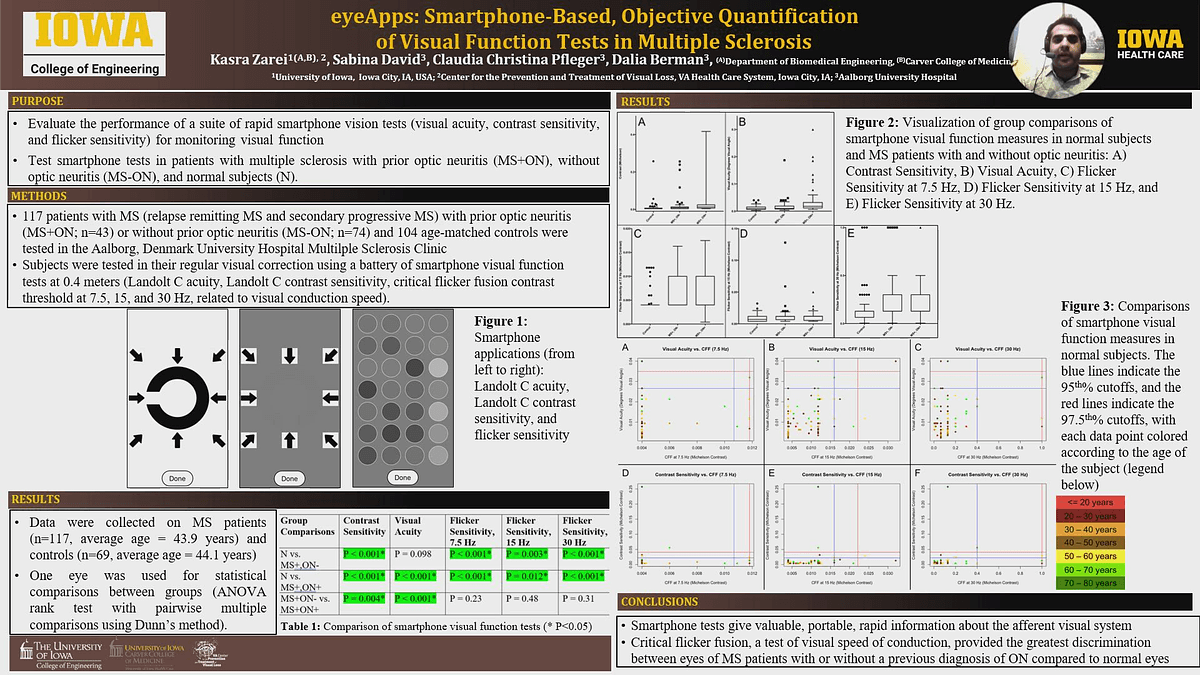
Purpose: In this study, the performance of a suite of rapid smartphone vision tests was evaluated for monitoring visual function in patients with multiple sclerosis (MS) with prior optic neuritis (ON), without prior optic neuritis, and normal subjects. We demonstrate how smartphone tests can differentiate MS without ON, MS with prior ON history and normal subjects in a clinic setting that can provide accessible standardized testing to neurology and ophthalmology clinics. Methods: In this pilot study, 117 patients with MS (relapse remitting MS and secondary progressive MS) with prior optic neuritis (MS+ON; n=43) or without prior optic neuritis (MS-ON; n=74) and 104 age-matched controls were tested in the Aalborg, Denmark University Hospital Multiple Sclerosis Clinic using a battery of smartphone visual function tests (Landolt C acuity, Landolt C contrast sensitivity, critical flicker fusion contrast threshold at 7.5, 15, and 30 Hz, related to visual conduction speed). Testing was performed with the patient wearing their glasses (if applicable). One eye was used for statistical comparisons between groups (ANOVA rank test with pairwise multiple comparisons using Dunn’s method). Results: Each smartphone test took approximately 15 seconds to complete and was intuitive enough that patients were able to immediately perform the visual task. Contrast at which 15 and 30 Hz critical flicker fusion occurred provided the greatest separation between MS patients and normal subjects, with or without prior optic neuritis. Conclusions: Portable and rapid smartphone tests of visual function, specifically visual acuity, contrast sensitivity, and flicker sensitivity, can give valuable information about the function of the afferent visual system, which could help in the triage and monitoring of patients with MS and patients with other vision threatening disorders. Interestingly, smartphone flicker sensitivity, a test of visual speed of conduction, provided the greatest discrimination between eyes of MS patients with or without a previous diagnosis of optic neuritis compared to normal eyes. This finding motivates the importance of using a behavioral visual test of visual conduction speed, such as critical flicker fusion or flicker sensitivity, which is resistant to optical blur, to monitor various causes of visual dysfunction.

Downloads

Transcript English (automatic)

Next from 2025 AMA Research Challenge – Member Premier Access

Using Antibiotic-Impregnated Discs for Infection Control in Implant-Based Breast Reconstruction

Using Antibiotic-Impregnated Discs for Infection Control in Implant-Based Breast Reconstruction

2025 AMA Research Challenge – Member Premier Access

Quinton Carr

22 October 2025