2025 AMA Research Challenge – Member Premier Access

October 22, 2025

Virtual only, United States

Would you like to see your presentation here, made available to a global audience of researchers?
Add your own presentation or have us affordably record your next conference.

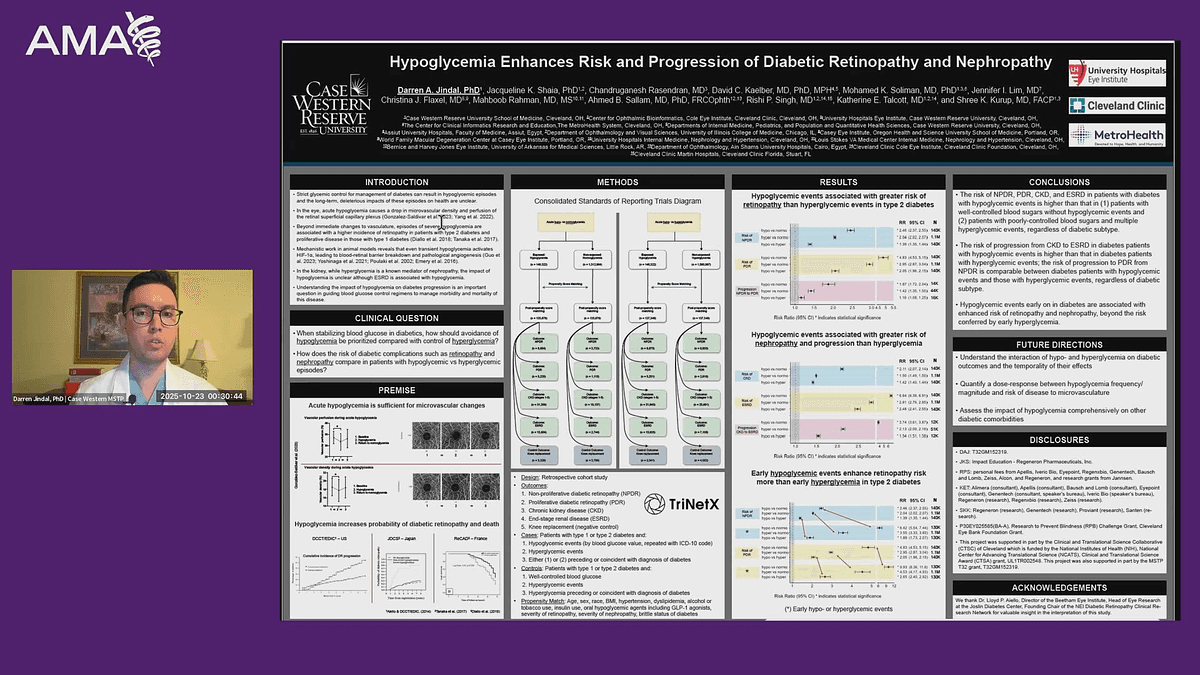
Background Strict glycemic control for management of diabetes can result in hypoglycemic episodes and the long-term, deleterious impacts of these episodes on health are unclear. Acute hypoglycemia causes a drop in microvascular density and perfusion of the retinal superficial capillary plexus. Additionally, severe hypoglycemia is associated with a higher incidence of retinopathy in patients with type 2 diabetes and proliferative disease in patients with type 1 diabetes. Understanding the influence of hypoglycemia on diabetes progression is an important question in guiding blood glucose control regimens to manage morbidity and mortality of this disease.

Methods We performed a retrospective cohort study using the TriNetX platform including up to 200k patients per cohort across 70 US health care organizations, selected by blood glucose value or ICD-10 code. We evaluated the impact of hypoglycemia on the risk and progression of diabetic retinopathy, relative to both hyperglycemia and normoglycemia, in participants with type 1 and type 2 diabetes. We simultaneously assessed the effect of hypoglycemia on another microvascular complication, diabetic nephropathy.

Results Participants with hypoglycemia were at an elevated risk for both non-proliferative diabetic retinopathy (NPDR) and proliferative diabetic retinopathy (PDR) compared to both glycemic-controlled and hyperglycemic participants. Hypoglycemia increased risk by up to 3.56 (3.14, 4.05) for NPDR, 4.83 (4.53, 5.15) for PDR in persons with type 2 diabetes and comparably in those with type 1 diabetes, relative to normoglycemia. Relative to hyperglycemia, hypoglycemia increased risk by up to 1.68 (1.53, 1.85) for NPDR, 2.05 (1.96, 2.15) for PDR in participants with type 2 diabetes and comparably in those with type 1 diabetes. Additionally, hypoglycemia elevated risk of progression from NPDR to PDR to a similar degree as hyperglycemia, up to 1.99 (1.56, 2.54) in persons with type 2 diabetes, relative to normoglycemia.

In the kidney, hypoglycemia increased risk of chronic kidney disease (CKD) 2.11 (2.07, 2.14); 1.42 (1.40, 1.44), end stage renal disease (ESRD) 6.64 (6.38, 6.91); 2.48 (2.41, 2.55), and progression from CKD to ESRD 3.74 (3.61, 3.87); 1.53 (1.51, 1.58), relative to both normoglycemia and hyperglycemia, respectively.

Conclusion Hypoglycemia is associated with increased risk of diabetic retinopathy and comparable risk of retinopathy progression, compared with hyperglycemia. Additionally, both elevated risk and risk of progression for diabetic nephropathy are associated with hypoglycemia. This study underscores the significant role of hypoglycemia on ocular and renal morbidity and highlights the importance of appropriately cognizant blood glucose control strategies to mitigate these outcomes.

Downloads

Transcript English (automatic)

Next from 2025 AMA Research Challenge – Member Premier Access

Back to the Fungimentals: Antimycotic Activity of Glycogen Synthase Kinase

Back to the Fungimentals: Antimycotic Activity of Glycogen Synthase Kinase

2025 AMA Research Challenge – Member Premier Access

Nathan Lach

22 October 2025