2025 AMA Research Challenge – Member Premier Access

October 22, 2025

Virtual only, United States

Would you like to see your presentation here, made available to a global audience of researchers?
Add your own presentation or have us affordably record your next conference.

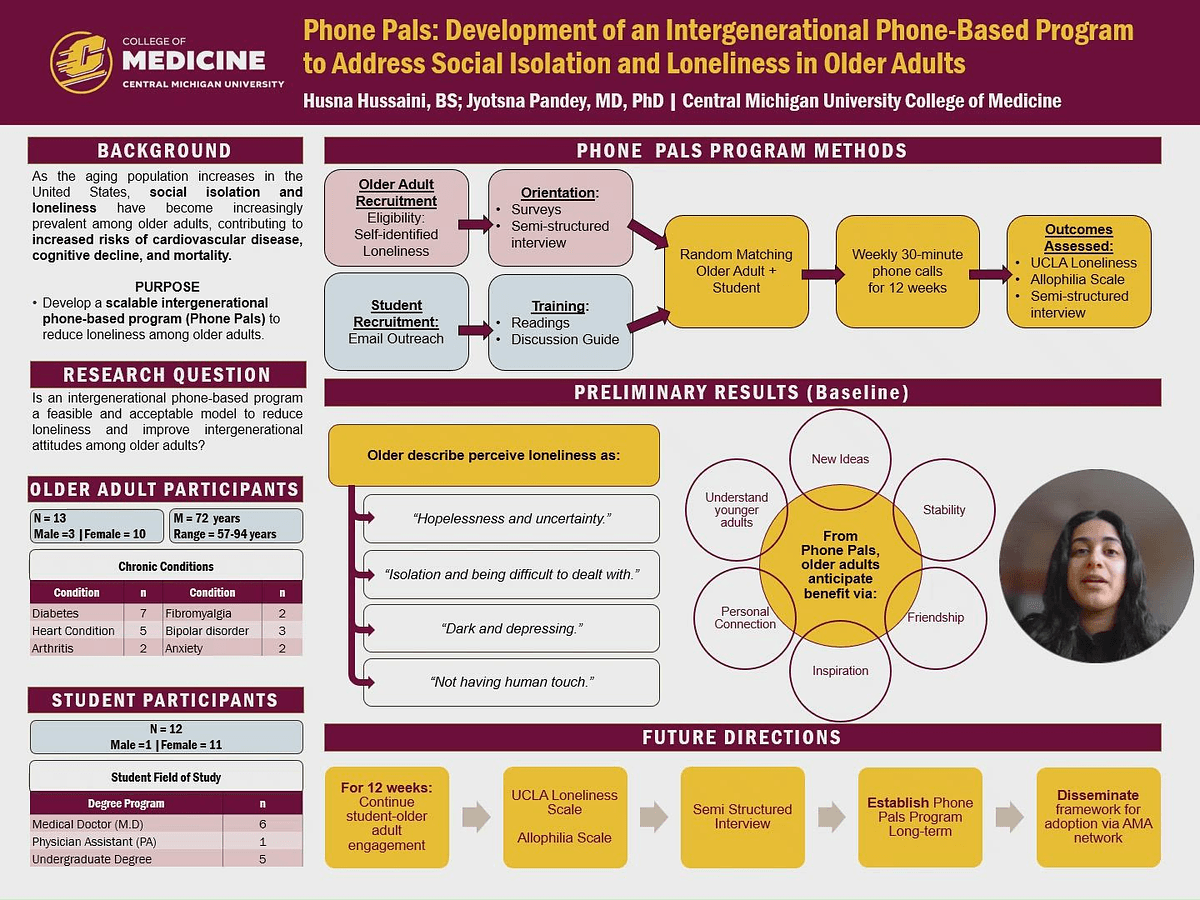
Background As the aging population increases in the United States, social isolation and loneliness have become increasingly prevalent among older adults, contributing to increased risks of cardiovascular disease, cognitive decline, and mortality (Courtin & Knapp, 2015). National estimates indicate that 29% of adults aged 50 to 80 report social isolation, while 33% report feelings of loneliness (Malani et al., 2025). Although technology-based interventions show promise in promoting social connectedness (Sen & Prybutok, 2021), few studies provide detailed frameworks for designing intergenerational phone-based programs connecting older adults with younger adults (Noble et al., 2022; Office et al., 2020).

This study aims to describe the design, recruitment process, and feasibility of an intergenerational phone-based intervention (Phone Pals) to reduce self-identified loneliness and social isolation among older adults, and to create a replicable model for use in other medical schools and institutions.

Methods Older adults are recruited through surveys distributed across Presbyterian Villages of Michigan senior living communities. Inclusion criteria includes self-identification of loneliness or social isolation. Undergraduate and medical student volunteers are recruited via email outreach to campus honors programs and student organizations. Older adults and students are randomly matched to promote transparency and reproducibility. Each pair engages in weekly 30-minute phone conversations over a 12-week period. As an orientation, older adults receive an overview of the program and guidelines on expectations, while student volunteers complete training that includes readings on geriatric issues and discussion guides covering social support, daily activities, and health maintenance. Primary outcomes include loneliness (UCLA Loneliness Scale) and perceptions of younger generations (Allophilia Scale). Semi-structured interviews will be conducted pre- and post-intervention to evaluate participant experiences and assess program satisfaction.

Results Currently, 13 older adults and 12 student volunteers have enrolled. All training materials and implementation protocols have been finalized, with program initiation scheduled in the coming weeks. This initial stage demonstrates that recruiting participants, organizing logistics, and building enthusiasm among older adults and student volunteers can be effectively achieved.

Conclusions Preliminary findings indicate that developing an intergenerational phone-based intervention is both feasible and adaptable. The Phone Pals program offers a detailed, scalable design that institutions can use to address social isolation among older adults. By combining accessible training materials and consistent telephone engagement, this approach can strengthen social connectedness and improve intergenerational attitudes. This study addresses a pressing public health challenge and provides a replicable strategy relevant to health systems. By documenting the design process, Phone Pals lays a foundation for other institutions to implement similar programs and contribute to empowering older adults.

Downloads

Transcript English (automatic)

Next from 2025 AMA Research Challenge – Member Premier Access

Angiomyolipoma-associated Metabolic Reprogramming in TSC: Insights from Serum Metabolomics

Angiomyolipoma-associated Metabolic Reprogramming in TSC: Insights from Serum Metabolomics

2025 AMA Research Challenge – Member Premier Access

James Gray

22 October 2025