2025 AMA Research Challenge – Member Premier Access

October 22, 2025

Virtual only, United States

Would you like to see your presentation here, made available to a global audience of researchers?
Add your own presentation or have us affordably record your next conference.

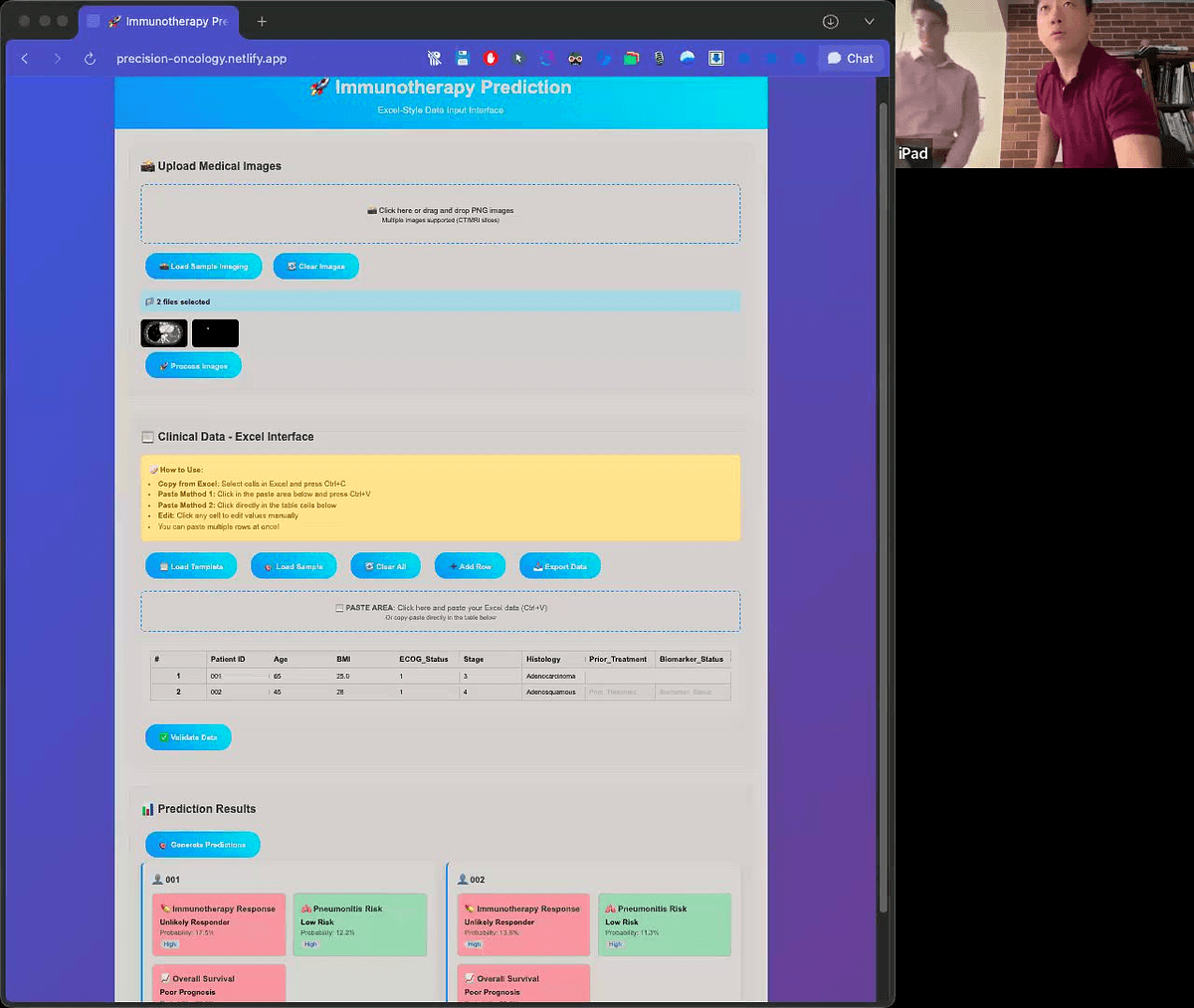
Background Immune checkpoint inhibitors (ICIs) have revolutionized non-small cell lung cancer (NSCLC) treatment, yet predicting durable benefit and toxicities like immune-related pneumonitis (IRP) remains challenging. We developed a novel deep-radiomics framework using baseline CT imaging to simultaneously forecast ICI efficacy and IRP risk, addressing critical unmet needs in precision immunotherapy selection. This integrates a patented CNN-enhanced methodology for unified tumor segmentation and multi-level feature extraction in a single neural network pass. Methods We analyzed baseline CT scans from 102 advanced NSCLC patients (stage IIIB-IV) receiving ICIs. Models predicted durable clinical benefit (DCB; response/stable disease ≥24 weeks per RECIST), IRP, overall survival (OS), and progression-free survival (PFS) across the cohort. Our integrated UNet extracted 348 radiomic features (shape, texture matrix, intensity, confidence metrics, deep vectors) from tumor and parenchyma. A 3D CNN fused these with clinical covariates (age, sex, ECOG, neutrophil-to-lymphocyte ratio, metastases including brain/bone, PD-L1) via ensemble learning with cross-validation. Performance used time-dependent AUROC, NPV, and Kaplan-Meier stratification. Results Among patients (median age 66, IQR 59.5-73.5; median follow-up 14 months, IQR 5-30), 58 (57.4%) achieved DCB, 13 (12.7%) developed IRP, and 80 deaths occurred. The framework yielded AUC 0.72 (95% CI 0.67-0.76) for DCB, 0.79 (0.73-0.86) for 12-month OS, 0.66 (0.52-0.80) for 36-month OS, 0.70 (0.67-0.73) for 12-month PFS, and 0.72 (0.61-0.83) for 36-month PFS. IRP prediction achieved AUC 0.72 with NPV 92.9% (sensitivity 53.8%, specificity 88.8%). Key predictors included radiomic features capturing tumor heterogeneity (particularly GLRLM descriptors), deep-learned embeddings, elevated NLR, and the presence of bone metastases, which collectively suggest that increased textural complexity may reflect underlying immune microenvironment characteristics contributing to both reduced efficacy and heightened toxicity. Risk stratification analyses revealed marked differences: high-risk patients exhibited a median OS of 11.8 months compared to not reached in the low-risk group (HR 2.97, 95% CI 1.84-4.80; p<0.001), and IRP incidence 26.9% vs. 7.9% (HR 3.58, 95% CI 1.20-10.66; p=0.014). Conclusion Our dual-model radiomics framework represents a substantial advancement in the field of precision oncology, as it concurrently identifies patients most likely to derive benefit from ICIs while proactively screening for elevated IRP risks—all without imposing additional testing burdens beyond standard baseline imaging, outperforming sequential pipelines (AUC 0.79 vs 0.590.66) and enabling riskadapted therapy and monitoring. A clinicianfriendly web demo (precisiononcology.netlify.app) delivers realtime predictions and is undergoing patent protection. Prospective validation in larger, multicenter cohorts is ongoing to confirm these findings and support widespread adoption in oncology practice.

Downloads

Transcript English (automatic)

Next from 2025 AMA Research Challenge – Member Premier Access

Previous ACLR Was Not Associated With Elevated Indices of Systemic Inflammation Prior to TKA

Previous ACLR Was Not Associated With Elevated Indices of Systemic Inflammation Prior to TKA

2025 AMA Research Challenge – Member Premier Access

Ayotomi Owoeye

22 October 2025