Would you like to see your presentation here, made available to a global audience of researchers?
Add your own presentation or have us affordably record your next conference.
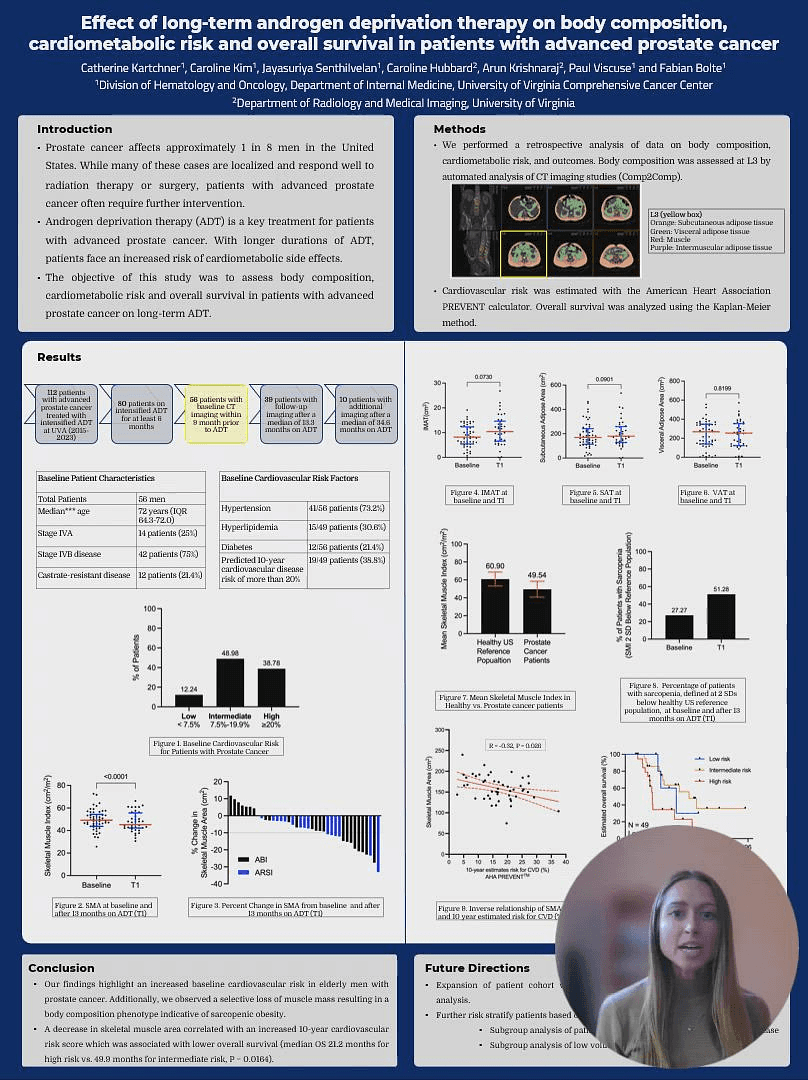
Background: Androgen deprivation therapy (ADT) is a key treatment for patients with advanced prostate cancer. With longer durations of ADT, patients face an increased risk of cardiometabolic side effects. This study aimed to assess body composition, cardiometabolic risk, and overall survival in patients with advanced prostate cancer on long-term ADT. Methods: We performed a retrospective analysis of body composition, cardiometabolic risk, and outcomes in patients with locally advanced or metastatic prostate cancer treated with at least 6 months of intensified ADT at the UVA Comprehensive Cancer Center between 2015 and 2023. Patients included had baseline imaging within 9 months prior to ADT initiation and follow-up imaging around 1 year. Body composition was assessed at the L3 vertebral level using automated CT analysis (Comp2Comp). Cardiovascular risk was estimated using the American Heart Association PREVENT™ calculator. Overall survival was analyzed using the Kaplan-Meier method. Results: A total of 56 men were included, with a median age of 72 years (IQR 64.3 72.0). Fourteen (25%) had stage IVA disease and 42 (75%) had stage IVB disease. Twelve (21.4%) were classified as having castrate-resistant disease. At baseline, many had independent cardiovascular risk factors including hypertension (73.2%), hyperlipidemia (30.6%), and diabetes (21.4%). Nineteen of 49 (38.8%) had a predicted 10-year cardiovascular disease risk >20%. Fifteen of 55 (27.3%) had sarcopenic obesity, defined as a skeletal muscle index two standard deviations below a healthy U.S. reference, with expansion of subcutaneous and visceral fat. After a median of 13 months on ADT, most patients (32/39, 82%) showed selective loss of muscle mass without significant fat loss. The median skeletal muscle area (SMA) decrease was 10.52 cm² (P < 0.0001). Lower muscle mass correlated with increased cardiovascular risk score (R = -0.32, P = 0.026). A higher cardiovascular risk estimate was associated with lower overall survival (median OS 21.2 months for high risk vs. 49.9 months for intermediate risk, P = 0.0164). Conclusions: This study highlights elevated baseline cardiovascular risk and a body composition profile consistent with sarcopenic obesity in elderly men with prostate cancer. Long-term ADT-induced muscle loss may worsen cardiometabolic health and is associated with reduced overall survival.