Would you like to see your presentation here, made available to a global audience of researchers?
Add your own presentation or have us affordably record your next conference.
Impact of Treatment Modality on Local Recurrence for Immunosuppressed Patients with cSCC
Background Prior literature has established that the immune system plays a significant role in the development and progression of non-melanoma skin cancers (NMSC), with studies demonstrating that immunosuppressed patients experience increased rates of local tumor recurrence, tumor metastasis, and mortality post-treatment of cutaneous squamous cell carcinoma (cSCC) compared to non-immunosuppressed patients. The worsened clinical outcomes in immunocompromised patients with cSCC necessitates further investigation into optimal treatment approaches for this population to reduce tumor morbidity and mortality. For this project, we evaluated the impact of host immunosuppression on clinical outcomes for patients with cSCC undergoing electrodessication and curettage (EDC), Mohs micrographic surgery (Mohs), and wide local excision (WLE).
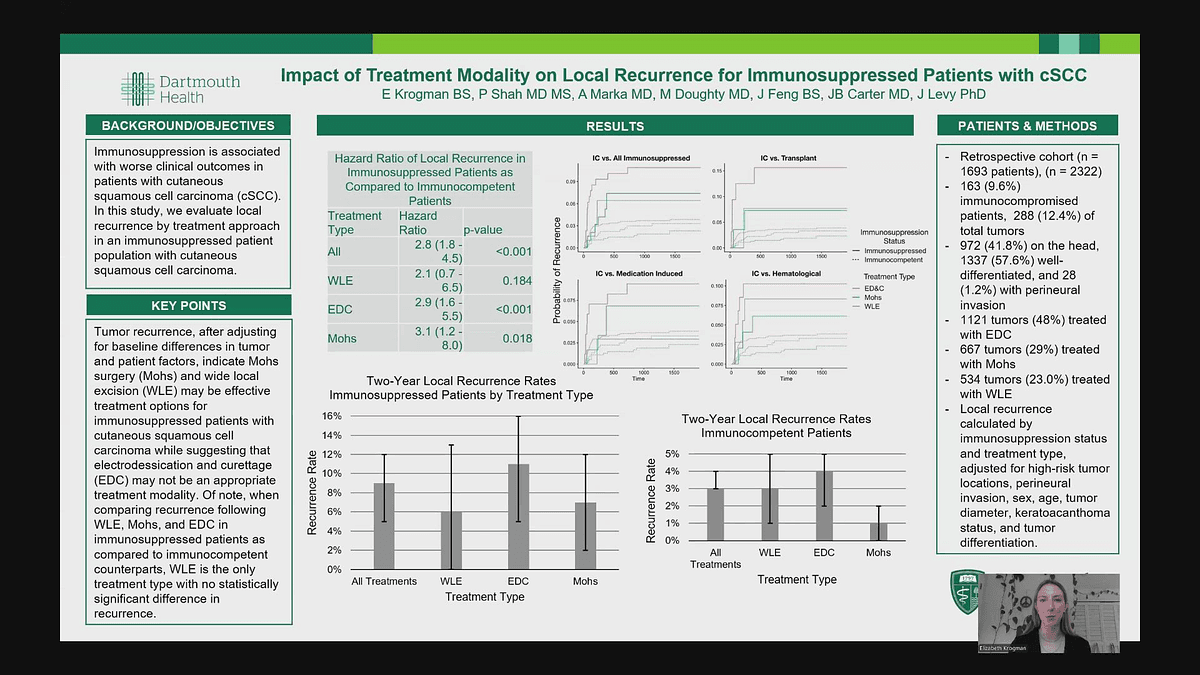
Methods We studied a retrospective cohort (n=1693) to assess differences in two-year local recurrence (LR) risk. Within the group, 163 (9.6%) were immunocompromised. Tumors (n = 2322) included 288 (12.4%) from immunosuppressed patients, 972 (41.8%) on the head, 1337 (57.6%) welldifferentiated, and 28 (1.2%) with perineural invasion. Most tumors were treated with EDC (1121, 48.3%), followed by Mohs (667, 28.7%), and WLE (534, 23.0%). Multivariable Fine and Gray sub distribution hazard regression models were used to compare local recurrence by immunosuppression status and treatment type, adjusted for high-risk tumor locations, perineural invasion, sex, age, tumor diameter, keratoacanthoma status, and tumor differentiation.
Results Immunosuppressed patients had higher LR compared to immunocompetent controls with 3% recurrence in immunocompetent patients and 9% recurrence in the immunosuppressed cohort. For immunocompetent patients, Mohs treatment resulted in 1% LR, WLE in 3%, and EDC in 4%. For immunocompromised patients, Mohs treatment resulted in 7% LR, WLE in 6%, and EDC in 11%. Of note, the subgroup analysis for LR following WLE in immunosuppressed patients was the only group to not be statistically significant.
Conclusion Given the higher likelihood of tumor recurrence among the immunosuppressed population, investigation into optimal treatment strategy to reduce such risk is important. Odds of tumor recurrence, after adjusting for baseline differences in tumor and patient factors, indicate Mohs and WLE may be effective treatment options for immunosuppressed patients with cutaneous squamous cell carcinoma while suggesting that EDC may not be an appropriate treatment modality.