2025 AMA Research Challenge – Member Premier Access

October 22, 2025

Virtual only, United States

Would you like to see your presentation here, made available to a global audience of researchers?
Add your own presentation or have us affordably record your next conference.

Abstract Title E-Cigarette Use Impairs Innate and Adaptive Immune Responses, Delaying Pulmonary Repair Authors: Ivan Marrufo1, Armando Marrufo2, Ferrah Kheradmand2 1 University of North Texas Health Sciences Center 2 Department of Medicine-Pulmonary, Critical Care, & Sleep Medicine, Baylor College of Medicine

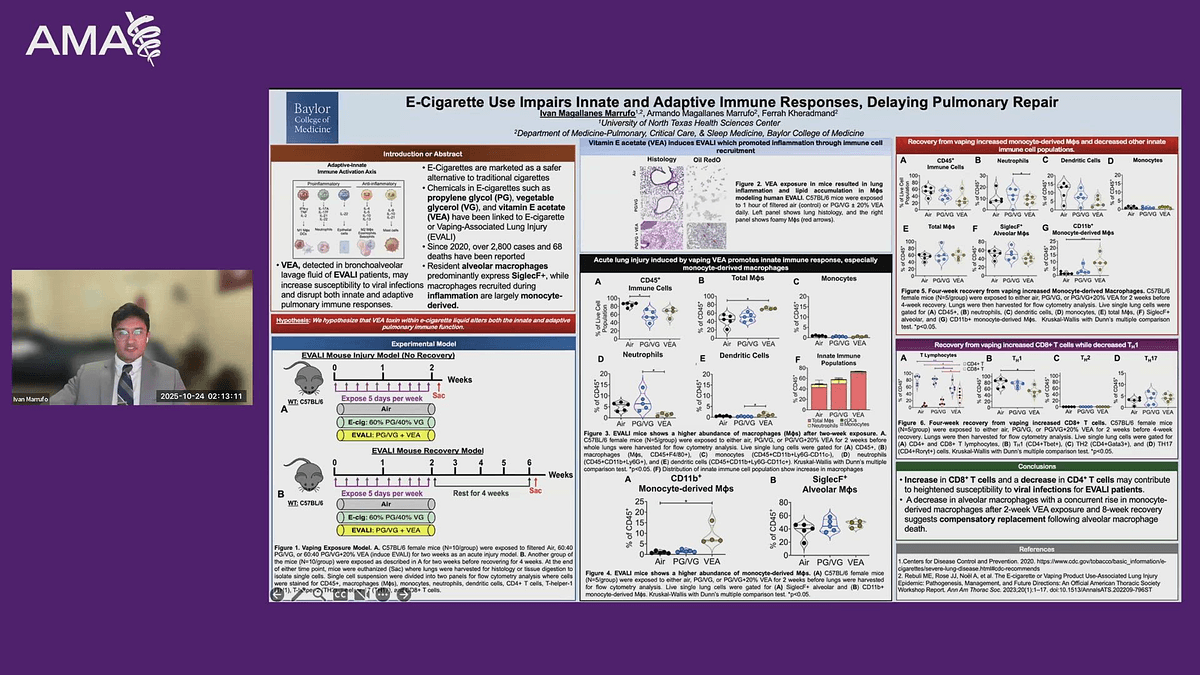
Background E-cigarettes are marketed as safer alternatives to traditional cigarettes and are widely used by adults and young adults. However, heated aerosolized components—particularly propylene glycol (PG), vegetable glycerol (VG), and vitamin E acetate (VEA)—have been linked to e-cigarette or vaping-associated lung injury (EVALI). Since 2020, over 2,800 cases and 68 deaths have been reported. VEA, detected in bronchoalveolar lavage fluid of EVALI patients, may increase susceptibility to viral infections and disrupt both innate and adaptive pulmonary immune responses. Therefore, we hypothesize that VEA toxin within e-cigarette liquid alters both the innate and adaptive pulmonary immune function.

Methods Mice were exposed to either air, PG/VG, or VEA for 2 weeks, followed by an 8-week recovery. Lung immune cells were analyzed by flow cytometry. Single-cell suspensions were stained with antibodies to identify macrophage and T cell subpopulations.

Results The results demonstrate that after a 2-week exposure to VEA, there was a significant increase in the total lung macrophage population compared to air-exposed controls. Lung macrophages were categorized into alveolar macrophages, resident cells native to the lungs, and monocyte-derived macrophages, originating from circulating monocytes and functioning in tissue repair and inflammation. Within the total macrophage population, VEA exposure led to a significant increase in monocyte-derived (CD11b⁺) and intermediate (CD11b⁺SiglecF⁺) macrophages, with a trend toward increased alveolar macrophages (SiglecF⁺). Following a 2-week exposure and an 8-week recovery period, VEA-exposed mice showed sustained increases in monocyte-derived (CD11b⁺) and intermediate (CD11b⁺SiglecF⁺) macrophage populations, alongside a decreasing trend in alveolar (SiglecF⁺) macrophages. Among adaptive immune cells, total T-lymphocytes were significantly increased after the 2-week exposure and 8-week recovery. Specifically, there was a significant increase in CD8⁺ T cells and a significant decrease in CD4⁺ T cells in VEA-exposed mice. Within the CD4⁺ T cell subset, pro-inflammatory Th1 cells were significantly decreased following VEA exposure and recovery.

Conclusion An increase in CD8⁺ T cells and a decrease in CD4⁺ T cells may contribute to heightened susceptibility to viral infections. Furthermore, the observed decrease in alveolar macrophages—alongside an increase in monocyte-derived and intermediate macrophage populations following a 2-week VEA exposure and 8-week recovery—may reflect a compensatory replacement mechanism driven by alveolar macrophage death.

Downloads

Transcript English (automatic)

Next from 2025 AMA Research Challenge – Member Premier Access

The Utility of Pulmonary Vein Isolation in Patients with Pre Excited Atrial Fibrillation

The Utility of Pulmonary Vein Isolation in Patients with Pre Excited Atrial Fibrillation

2025 AMA Research Challenge – Member Premier Access

Chelsea Amo Tweneboah

22 October 2025