Would you like to see your presentation here, made available to a global audience of researchers?
Add your own presentation or have us affordably record your next conference.
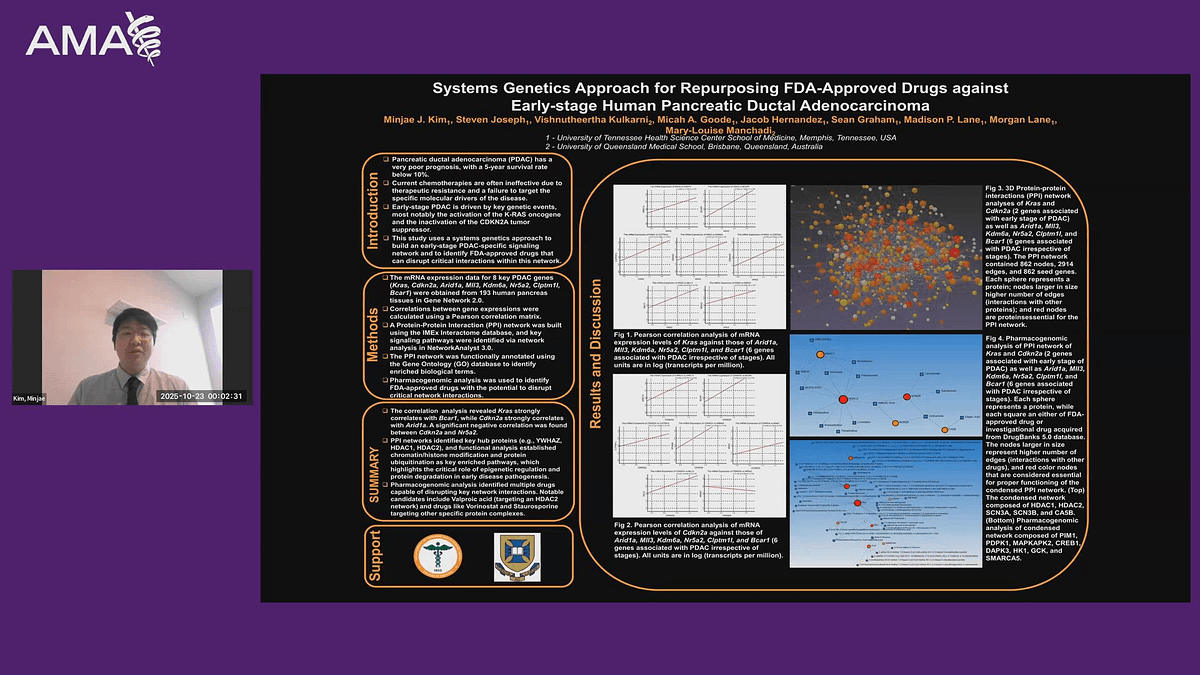
Background: Pancreatic ductal adenocarcinoma (PDAC) remains challenging to treat with a 5-year survival rate below 10 %. Its pathogenesis involves a series of genetic events with early stages involving tumorigenesis. Most notably, activation of the K-RAS oncogene and the inactivation of the CDKN2A tumor suppressor have been associated with early-stage development of PDAC. Current chemotherapies are often met with therapeutic resistance and fail to target this evolving molecular landscape. To address this gap, systems genetics was employed to construct early-stage PDAC-specific signaling network and identify FDA-approved drugs capable of disrupting key interactions. Methods: Expression levels of mRNA for 8 key genes involved in late pathogenesis of PDAC — Kras, Cdkn2a, Arid1a, Mll3, Kdm6a, Nr5a2, Clptm1l, and Bcar1—were acquired from 193 human pancreas tissues in Gene Network 2.0. Correlations in mRNA expressions were assessed using Pearson correlation matrix. Key signaling pathways were identified via network analysis in NetworkAnalyst 3.0. Protein-protein interaction (PPI) network was constructed using IMEx Interactome database. Functional annotation of PPI network was performed using Gene Ontology (GO) database to identify enriched biological processes, molecular functions, and cellular components. Pharmacogenomic analysis was employed to identify FDA-approved drugs with potential to disrupt critical interactions. Results: Correlation analysis revealed a strong positive association between Kras and Bcar1, and between Cdkn2a and Arid1a, alongside a significant negative correlation between Cdkn2a and Nr5a2. Protein-protein interaction (PPI) network analysis identified key hub proteins, including YWHAZ, HDAC1, and HDAC2. Functional enrichment of the network highlighted chromatin remodeling and protein ubiquitination as central pathways, underscoring the role of epigenetic regulation and protein degradation in early pathogenesis. Subsequently, pharmacogenomic screening nominated several drugs capable of disrupting critical network interactions, such as Valproic acid (targeting HDAC2), Vorinostat, and Staurosporine. Conclusion: Correlation matrix analysis demonstrated intricate co-regulatory gene network in early-stage PDAC, which drives dysregulation of epigenetic modification and protein degradation pathways, reflecting tumor ecosystem driven by genomic instability. Pharmacogenomic analysis identified clinically accessible candidates (valproic acid, vorinostat, and staurosporine) targeting multiple proteins within PPI network. Integrating these network-informed agents represents novel precision oncology strategies tailored to the complex biology of early-stage PDAC.