Would you like to see your presentation here, made available to a global audience of researchers?
Add your own presentation or have us affordably record your next conference.
Background
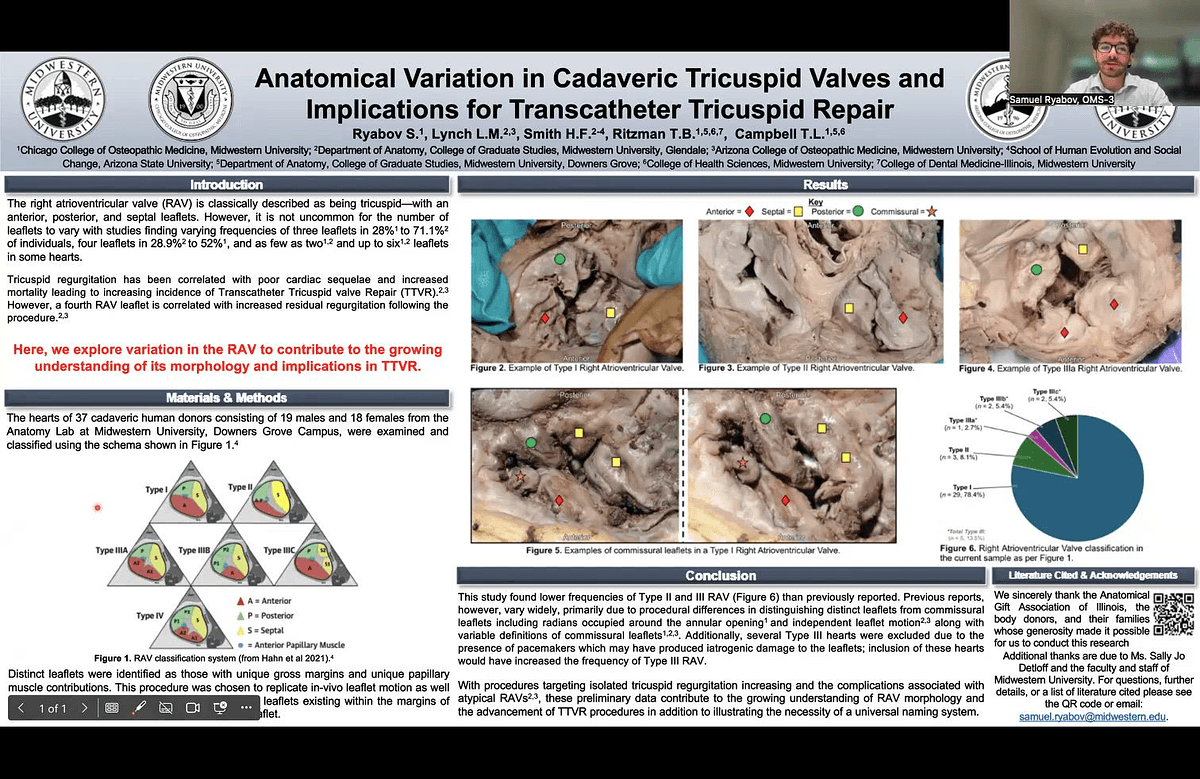
The right atrioventricular (tricuspid) valve (RAV) separates the right atrium and ventricle to inhibit retrograde blood flow during ventricular systole. Although traditionally described as having three leaflets — anterior, posterior, and septal — it is not uncommon for the RAV leaflet number to vary with previous studies finding three leaflets in 28% to 71.1%, four leaflets in 28.9% to 52%, and as few as 2 and as many as 6 have been documented. An understanding of RAV functional morphology is essential for successful transcatheter tricuspid valve repair (TTVR) procedures for the treatment of tricuspid regurgitation. Although less common than mitral valvular disorders, tricuspid regurgitation has been shown to correlate with poor cardiac sequela and increased cardiac mortality, leading to increasing incidence of TTVR procedures. This ongoing study explores the prevalence of variation in RAV leaflet numbers using cadaveric donors at Midwestern University to contribute to the understanding of its morphology and implications for TTVR.
Methods
Thirty-seven cadaveric donor hearts consisting of 19 males and 18 females were examined and classified according to the schema—Type 1 (three leaflets), Type 2 (two leaflets), and Type 3 (four leaflets). The presence of a fourth leaflet was further subdivided based on additional leaflet location—type 3A (anterior), 3B (posterior), and 3C (septal). Individual leaflets were defined during dissection as existing within a distinct gross margin of the valve and having unique papillary muscle attachments. This procedure allowed us to distinguish discrete additional leaflets from commissural leaflets that exist between two leaflet margins but function in tandem with a single leaflet.
Results
This study found that of the 37 hearts, 29 (78.4%) were Type 1, three (8.1%) were Type 2, and five (13.5%) were Type 3. Of the Type 3, one was Type 3A (2.7%), two were Type 3B (5.4%), and two were Type 3C (5.4%).
Conclusion
This study found lower frequencies of a fourth leaflet than previous studies. However, the findings of these studies vary widely, primarily due to procedural differences in defining and distinguishing leaflets from commissural leaflets arising from a lack of universal naming protocols. Regarding TTVR, the presence of a fourth RAV leaflet is clinically significant as it is associated with increased residual regurgitation following procedure in those treated for isolated tricuspid regurgitation. These preliminary data contribute to the growing understanding of RAV morphology, which has the potential to contribute to current and future advancements in the treatment of tricuspid regurgitation.