keywords:
face processing
computer science
artificial intelligence
machine learning
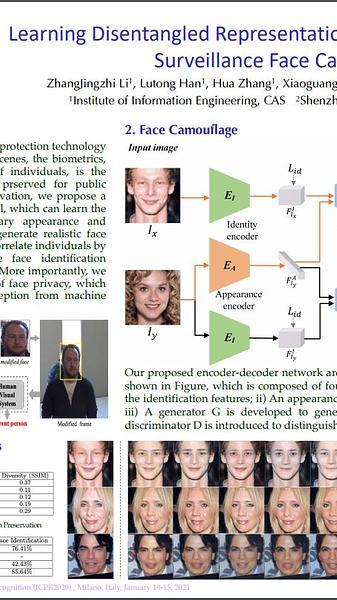
Face recognition technology raises privacy concerns as face images contain identity and soft biometric attributes. Existing methods struggle to balance privacy, image quality, and identity retention, often neglecting human perception. We propose a diffusion-based identity-preserving face privacy method that enhances privacy at the cognitive level while maintaining identity recognition. Unlike GAN-based approaches, our model generates higher-quality, more diverse, and fine-detail privacy-enhanced faces. It selectively obfuscates identity-critical regions and enables flexible attribute modifications via natural language prompts, eliminating reliance on predefined classifiers. Additionally, our method significantly reduces inference time from minutes to seconds, improving practical feasibility. Experiments show superior performance over state-of-the-art methods in both algorithmic and human cognition-based evaluations, effectively confusing human observers while ensuring reliable machine-based identity recognition.