keywords:
dynamic systems modeling
sociology
cognitive humanities
behavioral science
group behaviour
agent-based modeling
humanities
social cognition
computational modeling
complex systems
mathematical modeling
computer science
bayesian modeling
decision making
action
psychology
representation
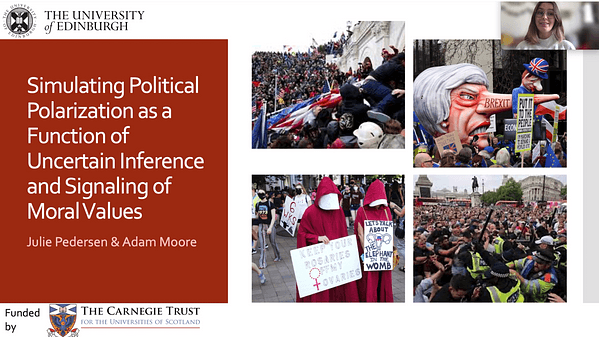
The rise in political polarization disrupts political consensus and causes individual harm. We build on a theoretical framework of political polarization that emerges from uncertain political identity inference and signaling mediated by moral values. The current computational model extends this framework with rational inference tools and graph theory to better capture the complex dynamics of value-based inference and group formation. We find that minimally constrained signaling and promiscuous inference and updating of moral values leads to general network homogeneity. This contrasts with previous models using the same overarching theoretical framework and highlights the influence of model implementation, which should be further explored to triangulate the necessary causes of polarization. We discuss future extensions to the model to explore what facilitates political polarization as found in previous studies and the real world.